What is a Bill of Lading?
By admin
/ March 19, 2024
In the dynamic realm of international trade, the ‘bill of lading’ holds a pivotal role in ensuring the smooth transportation…
Read More


By Adarsh Gaikwad, Researcher at NITISARA
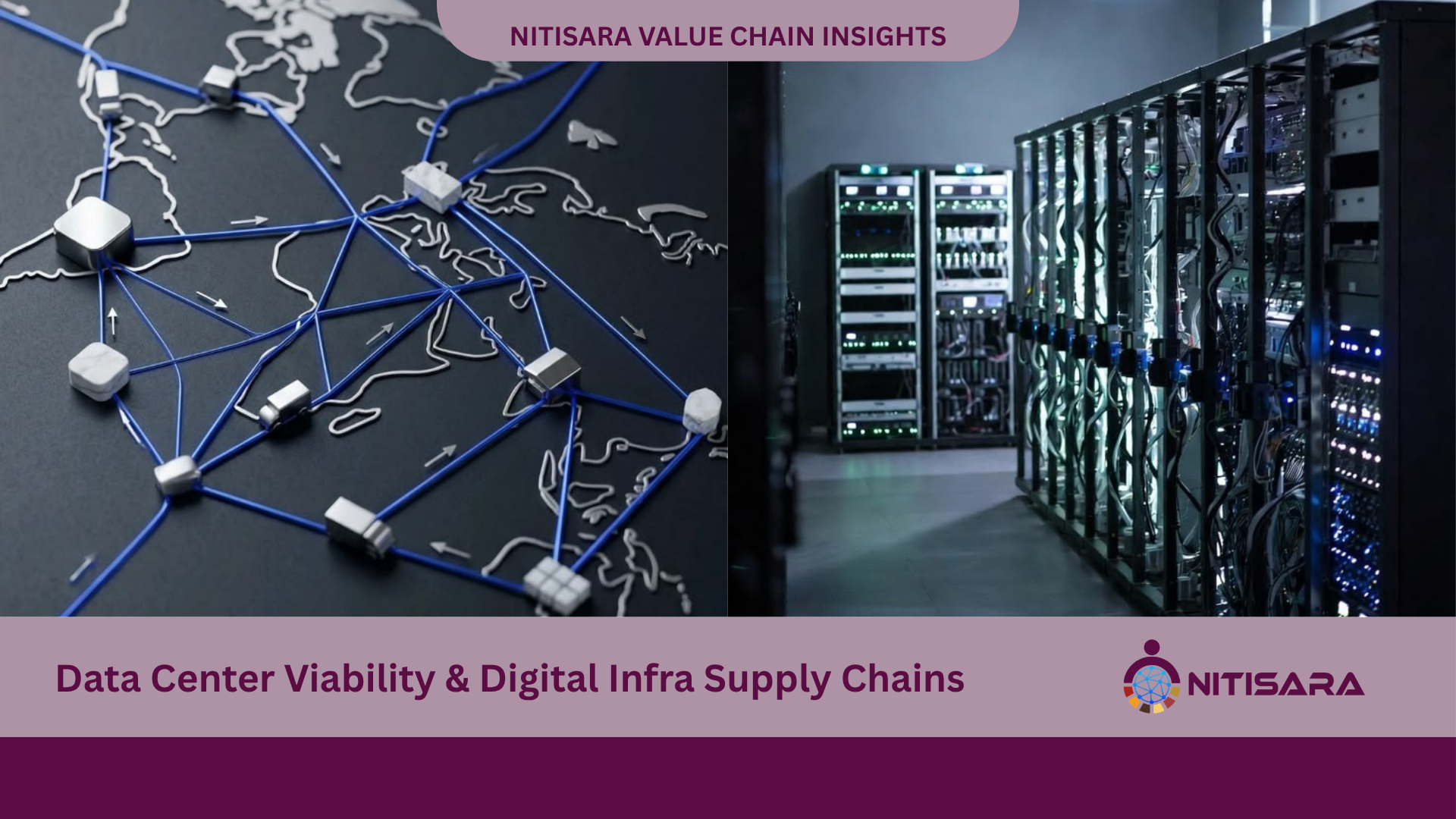
The AI economy runs on physical assets that are becoming as strategically significant as oil fields or semiconductor fabs. This piece looks at how the explosive demand for AI computing is reshaping global logistics, energy systems, and infrastructure investment in ways that most supply chain analyses have yet to keep pace with. It covers chip supply, cooling systems, energy demand, and connectivity infrastructure, and the policy environment through which India is positioning itself as a major node in the global digital infrastructure network, and asks what it actually takes to build and sustain the physical infrastructure that AI depends on, and where the constraints are most likely to bind.
Global spending on data center equipment and infrastructure reached $290 billion in 2024. It is expected to near $1 trillion by 2030. The IEA estimates that data center electricity use will double to 945 TWh by 2030, increasing at an annual rate of 15%. This growth rate is four times that of global electricity demand. A single AI training run for a frontier model can use as much electricity as 100 average American homes do in a year. NVIDIA holds about 90% of the AI accelerator chip market. Its data center revenue grew from $35.6 billion to $51.2 billion in just three quarters of 2024. The AI economy runs on physical infrastructure, and that infrastructure faces supply chain issues that money alone cannot resolve quickly.
Many people assume the digital economy is weightless, operates in the cloud, takes up no physical space, and requires no industrial supply chains. This assumption is wrong, and the costs of maintaining it are rising. Each AI query, large language model inference, and training run relies on computing hardware located in physical buildings. These buildings require complex cooling systems, fiber-optic networks for connectivity, and grid-sourced electricity. At its core, the AI economy is about physical manufacturing and logistics.
The scale of this physical demand is outpacing most infrastructure planning. Data center companies in Virginia alone requested 40.2 GW of new power connections from Dominion Energy in February 2025, up from 21.4 GW just eight months earlier. Lead times for data center equipment such as diesel generators, transformers, power distribution systems, and advanced cooling systems can now extend for several years in some cases. Building AI infrastructure resembles building a new industry from the ground up, in a tight timeframe, with limited resources at every level.
The AI compute supply chain starts with chips, and those chips start with NVIDIA. The company has about 90% of the AI accelerator market, making it the most important upstream supplier in the entire AI infrastructure ecosystem. When NVIDIA reports that its data center revenue increased from $35.6 billion to $51.2 billion within three quarters, it signals how fast global AI compute capacity is growing and how dependent that growth is on one company’s manufacturing capabilities.
The chips also face upstream challenges. NVIDIA’s most advanced GPUs are made exclusively by TSMC using ASML’s EUV lithography machines. The risk in the AI chip supply chain is directly tied to the broader semiconductor supply chain discussed elsewhere in Nitisara’s research. Export controls add another layer of difficulty. U.S. restrictions on the sale of advanced AI chips to China have accelerated Chinese efforts to develop domestic alternatives while limiting the market for companies supplying global AI infrastructure. The geopolitics of chips and data centers are interconnected issues.
Thermal management in AI data centers is a significant supply chain challenge that the tech industry has yet to fully solve. Traditional data center servers operate at densities of 8-10 kilowatts per rack. AI-optimized GPU racks, by contrast, work at 30 to 100 kilowatts per rack, with the most advanced setups aiming for even higher densities. Air cooling, the standard method for three decades, cannot effectively manage this level of heat.
The industry is moving to liquid cooling, including direct-to-chip and immersion systems. These methods cool heat much more efficiently, but they require different facility designs, new equipment supply chains, and specific operational expertise. Cooling infrastructure adds a 20-30% cost increase in AI-ready data center builds compared to regular facilities. Major suppliers of advanced cooling systems, such as Vertiv and Schneider Electric, are also dealing with supply chain issues as demand exceeds their production capacity. In India, AI-ready racks cost ₹8 to 12 lakh each, and cooling systems add ₹8 to 15 crore per MW of installed capacity. The cooling supply chain, rather than the chip supply chain, might ultimately determine how quickly AI infrastructure can be deployed.
The energy needs of AI data centers are putting pressure on electricity systems in ways the power sector has never seen before. Data center electricity consumption for AI servers is expected to grow at 30% per year through 2030, while conventional servers grow at 9% annually. That gap isn’t just more demand for power — it’s a different kind of demand: constant, highly reliable, and arriving at a rate that utility capital expenditure cycles cannot accommodate.
In response, the industry has begun moving toward direct power procurement. For example, Microsoft signed a Power Purchase Agreement with Iberdrola for 150 MW of dedicated wind power in Spain to secure a long-term clean energy supply for AI operations. Microsoft is also testing hydrogen fuel cells to power server rows and is considering Small Modular Reactors to supply data centers. The logic is straightforward: if the grid can’t ensure the necessary power, you create your own supply. Energy procurement is now as crucial for data center operators as hardware procurement.
India’s data center market is at an important turning point. Installed capacity grew from around 375 MW in 2020 to about 1.5 GW in 2025, a fourfold increase in five years. In 2025 alone, a record 387 MW was added, marking a 103% year-on-year increase. Capacity is projected to reach 6.5-9 GW by 2030. The sector attracted over $14 billion in investment between 2020 and 2025, with announced projects estimated at $60-70 billion over the next five years. Google is putting in $15 billion, Microsoft is investing $17.5 billion, and Amazon plans to invest up to $35 billion in India by 2030. The Adani Group has committed $100 billion through 2035 for a 5 GW renewable-powered data center platform in partnership with Google, Flipkart, and Microsoft.
The structural drivers are strong. India has over one billion internet subscribers, average monthly data use has almost tripled since 2019, and the Digital Personal Data Protection Act of 2023 requires data localization, pushing multinationals to build infrastructure in India. The IndiaAI Mission, backed by around $1.24 billion, is rolling out 10,000 GPUs through public-private partnerships while fostering the development of local foundational models. Technology partnerships between the U.S. and India, along with India’s position as an aligned alternative to China-linked infrastructure, are attracting investments from hyperscalers that might have otherwise expanded elsewhere in the Asia-Pacific.
| Indian Hyperscale Metric | Data Tracked | Structural Assessment & Risks |
|---|---|---|
| Capacity Growth Rate | 1.5 GW total in 2025 (387 MW added) | Massive momentum. A 103% YoY growth spike driven by $14B in investments between 2020-25. |
| Hyperscale Pipeline | $60B – $70B announced projects | Massive commitments including Adani ($100B pipeline), Amazon ($35B), MSFT ($17.5B), Google ($15B). |
| Global Pipeline Deficit | India 1.5 GW vs. US 53.7 GW | Headline growth remains small vs. international leaders. China stands at 19.6 GW. |
| Workforce Expansion Need | 25k-35k baseline talent pool | The data center engineering workforce must double by 2027 to execute active pipeline targets. |
| Environmental / Asset Risks | 60-80% facility water stress risk | Severe regional stress. Liquid-cooled AI facilities conflict directly with local water resource limits. |
While the investment figures are impressive, genuine structural concerns remain. India’s data center capacity is still small compared to the U.S.’s 53.7 GW and China’s 19.6 GW. Mumbai dominates, contributing 54% of total capacity, and that concentration creates geographic risk while straining the city’s power and connectivity infrastructure. Around 60-80% of Indian data centers face high water-stress risks, a major concern because AI facilities require large amounts of water for cooling. GPU availability is also dependent on imports, with no domestic production of AI accelerator chips and limited near-term prospects for that to change. The data center engineering workforce consists of 25,000 to 35,000 professionals and will need to nearly double by 2027 to support planned expansions.
The connectivity infrastructure in India also varies widely. Mumbai’s status as the country’s data center hub partly stems from its 14 submarine cable landing stations that offer the international bandwidth hyperscale facilities need. Other cities are working to improve connectivity, but they are years behind. Uncertainty over tariffs on IT and telecom equipment has delayed spending decisions, prompting operators to strengthen local supply chains in ways the broader component ecosystem isn’t fully prepared to support.
The data center is the infrastructure of the AI economy, much as a port is the infrastructure of maritime trade. What happens inside it is digital. What it requires to function is physical: chips that run hot, cooling systems that must manage that heat, power that must be reliable and increasingly clean, and connectivity infrastructure that determines how fast data moves between the facility and its users.
India’s digital infrastructure ambitions are backed by genuine capital commitments and a policy environment that is actively enabling investment. The constraints that remain, from GPU import dependency to water availability to workforce gaps, are real and will require sustained attention alongside the headline investment announcements. The nations and companies that build the most resilient, energy-efficient, and well-connected data center supply chains in the next five years will define the AI economy’s physical geography for the following decade. India has the opportunity to be central to that geography. Realizing it will require closing the gaps between what is announced and what is actually built.
The views expressed do not represent the company’s position on the matter. This is not AI-generated content. Stay informed through the Nitisara Platform and Blogs, and adapt to emerging trends to thrive in the competitive global marketplace. – https://nitisara.org/category/blogs-updates/