What is a Bill of Lading?
By admin
/ March 19, 2024
In the dynamic realm of international trade, the ‘bill of lading’ holds a pivotal role in ensuring the smooth transportation…
Read More


By Adarsh Gaikwad, Researcher at NITISARA
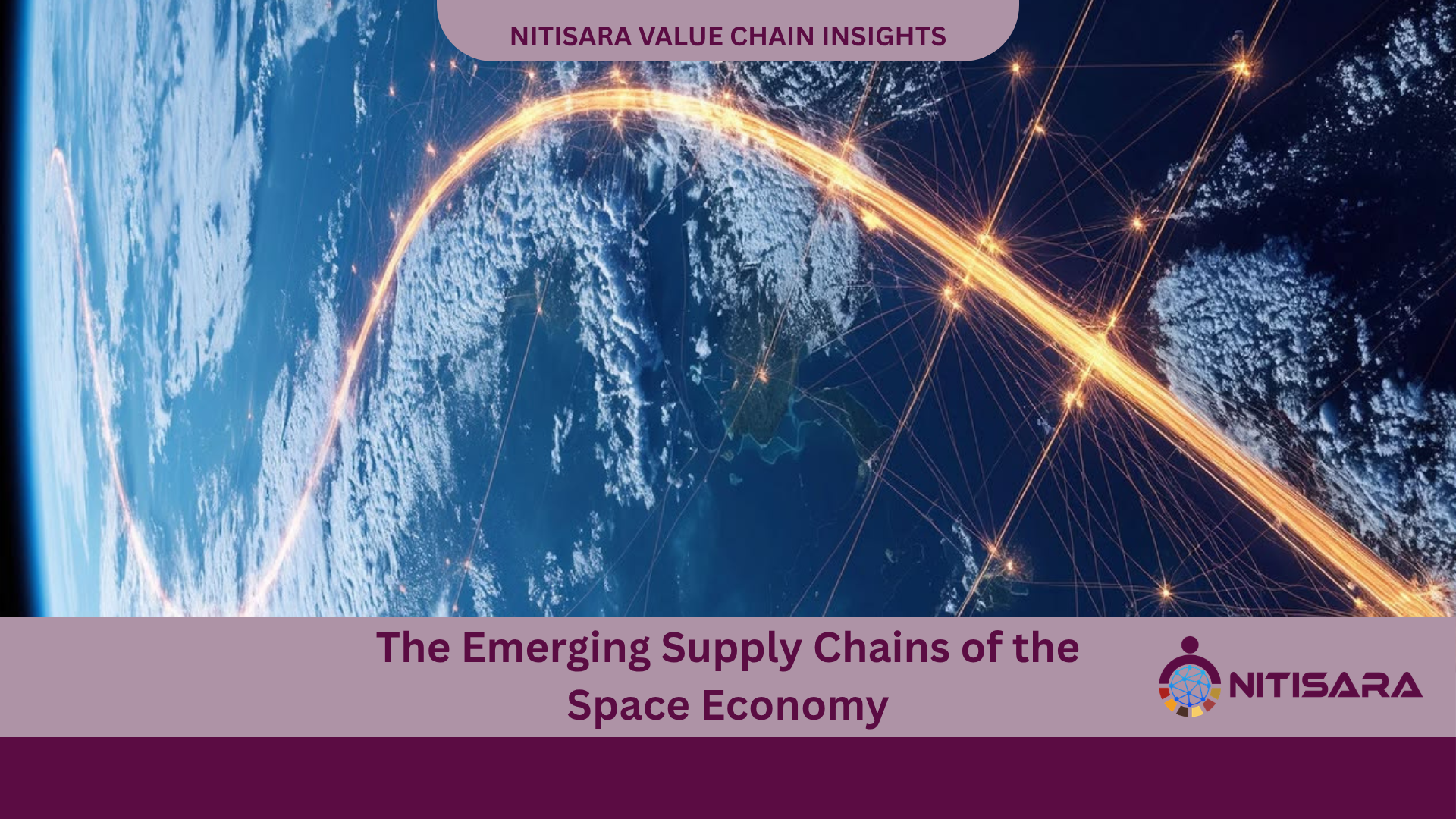
This piece looks at the global space economy and the supply chains that are quietly becoming as strategically important as those in semiconductors or energy. Space has shifted from a government prestige project into a commercial-industrial system, and the companies and countries that build the manufacturing infrastructure behind it will shape the next wave of the global economy. It covers launch infrastructure, satellite manufacturing, orbital logistics, the emerging business of space-based data centers, and India’s growing role in the commercial space supply chain, and asks what it actually takes to build a space economy, and whether capability in one part of the chain is enough to capture value across the rest of it.
The global space economy reached $613 billion in 2024, growing 7.8% year-on-year, and is projected to exceed $1.8 trillion by 2035. In the first half of 2025, a rocket lifted off to orbit every 28 hours. At the end of 2024, 11,539 satellites were operating in Earth orbit, more than three times the 3,371 in service just four years earlier. The commercial sector now accounts for 78% of total space economy activity. Space is no longer a frontier. It runs on supply chains, manufacturing ecosystems, and geopolitical stakes like any other industry.
For most of human history, space was the domain of governments. The rockets were state-built, the satellites state-owned, and the costs absorbed by defense and scientific budgets. That structure has not disappeared, but it has been fundamentally transformed. The commercial sector is now the engine of the space economy, and the supply chains that feed it resemble those of other capital-intensive manufacturing industries: concentrated, technically complex, and increasingly contested.
The shift matters because of what satellites actually do. A prolonged outage of the U.S. GPS system alone would cost roughly $1 billion per day across agriculture, logistics, finance, and communications. Satellite broadband revenue grew 29% in 2024, with subscribers rising 46% as Starlink expanded and Amazon’s Kuiper entered the market. The data and connectivity provided by space infrastructure have become load-bearing elements of the global economy. The supply chains behind that infrastructure are critical, not peripheral.
Launch is the first constraint in the space supply chain. You can build the most capable satellite in the world, but if you cannot get it into orbit affordably and on schedule, it has no commercial value. For most of the past three decades, launch costs were a significant barrier to the commercialization of space. The development of reusable launch vehicle technology, led primarily by SpaceX, changed that calculation faster than most of the industry expected.
In 2024, the global commercial launch market generated $9.3 billion in revenue, up 30% from 2023. SpaceX accounted for more than half of all global launches in the first half of 2025, with 81 of 149 orbital missions. The economic implications of this concentration are significant. When a single commercial provider dominates more than half of global launch capacity, every other company and country that depends on launch services is exposed to a single point of risk. Governments across Europe, Asia, and the Middle East are investing in sovereign launch capability precisely because they understand that dependence on a foreign commercial provider for access to orbit is a strategic vulnerability, not just a procurement preference.
Satellite manufacturing revenue reached $20 billion in 2024, a 17% increase over 2023. U.S. firms built 83% of the commercial satellites launched during the year and accounted for 69% of global satellite manufacturing revenue. The upstream supply chain for satellite manufacturing includes precision optical systems, radiation-hardened electronics, propulsion components, composite structures, and specialized software: a set of inputs that are technically demanding, difficult to substitute, and in several categories subject to export controls that limit their availability to non-allied nations.
The miniaturization of satellite technology is reshaping who can participate in this market. Small satellites and CubeSats, which can be manufactured at a fraction of the cost and time of traditional large satellites, have opened the upstream market to a much wider range of companies and countries. They have also created demand for a new category of launch service: dedicated small-satellite launch, where the customer needs a specific orbit at a specific time rather than a rideshare slot on a vehicle headed elsewhere. This is a supply chain opportunity that countries like India, with cost-competitive engineering capability and a proven launch track record, are actively targeting.
The concept of orbital logistics is still new enough that most people outside the industry have not heard it used. But it is already a real and growing business. In-orbit servicing, satellite refueling, debris removal, and the transfer of satellites between orbits are all services that existing and planned spacecraft are beginning to offer commercially. These are near-term commercial necessities, not science fiction, driven by the rapid growth of satellite constellations and the rising cost of replacing assets already in orbit rather than servicing them.
Looking further ahead, the cislunar economy, spanning low Earth orbit through to the Moon, is being built on supply chain thinking. NASA’s Artemis program and commercial ventures are designed to manufacture and sustain assets in deep space using in-situ resources rather than launching them from Earth. In-situ resource utilization, using lunar regolith, water ice, and other space-available materials for fuel and manufacturing, is the long-term answer to the cost problem of Earth-based logistics. The supply chain logic is identical to that of any other industry: source inputs closer to where you need them, and you reduce costs and delivery time. In space, that logic operates at a scale that changes what is economically possible.
The idea of placing data centers in orbit has moved from speculative to seriously funded in the last two years, and it fits the same supply chain logic that runs through the rest of this piece. Terrestrial data centers are constrained by land, cooling water, and grid capacity, all of which are becoming harder to secure as AI compute demand grows. Orbit offers continuous solar power without atmospheric interference and the vacuum of space as a natural heat sink, which could solve the two most expensive line items in data center operating costs. But the economics only work if the rest of the supply chain matures alongside it: launch costs need to fall further to make it viable to send racks of servers into orbit, radiation-hardened components need to scale to survive the environment without exotic pricing, and in-orbit servicing needs to be reliable enough to replace failed hardware without deorbiting the entire facility. This is a downstream application, not a standalone technology bet, and it depends entirely on upstream capability in launch, manufacturing, and orbital logistics being solved first. For India, this is worth watching rather than chasing immediately. The country’s cost advantage in launch and its growing satellite manufacturing base give it a plausible entry point, but orbital data centers would require a depth of radiation-hardened electronics and thermal engineering that the domestic supply chain has not yet developed. The space economy’s future segments will reward whoever has already solved the boring, capital-intensive fundamentals, not just whoever announces the most futuristic use case first.
Ex.The Exploration Company
TEC is building Europe’s reusable space logistics future: orbital, lunar spacecraft for cargo and in-orbit servicing today, crews tomorrow. Since 2021, we’ve grown to 500+ people, with 1.28 in contracts and 300M raised
India’s space economy is currently valued at approximately $8.4 billion, representing roughly 2% of the global total. The stated ambition is to grow this to $44 billion by 2033, capturing 8% of the global space market and generating $11 billion in exports. The foundation for this ambition is real. Between 2015 and 2024, India launched 393 foreign satellites for over 30 countries, generating nearly $439 million in commercial foreign exchange. ISRO’s launches are 30 to 40% less expensive than those of major international competitors, giving India a structural cost advantage in the growing small satellite launch market.
The Indian Space Policy 2023 and the creation of IN-SPACe as a single-window regulatory body have opened the space supply chain to private participation in ways not possible under the previous government-only model. As of March 2025, IN-SPACe had received over 658 applications from private entities across satellite development, launch services, and deep space exploration, with more than 1,200 startups and 6,400 users registered on its platform. The number of space startups in India grew from just 1 in 2022 to nearly 200 by 2024. The ₹1,000 crore Antariksh Venture Capital Fund is designed to support this ecosystem at the early-stage funding level, where private capital has been most reluctant to commit.
The private sector is beginning to produce tangible results. Agnikul Cosmos flew the world’s first suborbital flight of a single-piece 3D-printed engine in May 2024 and plans its first orbital mission in 2026. Skyroot Aerospace is targeting its first orbital launch of the Vikram-1 rocket from Sriharikota in mid-2026. Bellatrix Aerospace is producing green propulsion systems for satellite manufacturers and developing an orbital transfer vehicle. This is hardware already in build and on test stands, not just announcements.
The honest picture of India’s space supply chain has significant gaps alongside its genuine strengths. Two consecutive PSLV failures in May 2025 and January 2026 exposed vulnerabilities in manufacturing quality and supply chain management at ISRO’s own production level, at a point when commercial demand for launch services is growing. Funding for Indian space startups fell by more than 53% in 2024 compared with 2023, and late-stage capital remains difficult for companies moving from prototype to operational hardware. Some firms have incorporated holding entities abroad to access better funding terms and to avoid the 18% GST that Indian companies pay on domestic PSLV launch services, a tax from which foreign customers are exempt.
The Economic Survey 2025-26 flagged stagnation in real-terms space budget allocation and declining capital expenditure, cautioning that launch service export earnings may be masking deeper structural weaknesses in manufacturing quality and supply chain reliability. India also remains subject to the Missile Technology Control Regime, which limits access to certain dual-use components and restricts collaboration with some allied space programs. The IN-SPACe and ISRO Decadal Vision identifies the need to develop upstream manufacturing capability across the full value chain, from components and sub-systems to complete satellite platforms, rather than relying on imported critical parts assembled domestically.
The space economy is already a $613 billion industry growing at nearly 8% annually, and its supply chains, spanning launch, satellite manufacturing, orbital logistics, and now the emerging bet on orbital data centers, are becoming as strategically significant as those in semiconductors or energy. Each of these layers follows the same rule: the flashiest application is downstream of the least glamorous capability. A data center in orbit is only as viable as the launch cost, radiation-hardened hardware, and servicing infrastructure built beneath it, and the same is true for every other segment covered here.
India has a credible foundation within this system: cost-competitive launch services, a growing private-sector ecosystem, and a genuinely enabling policy framework. The ambition to reach $44 billion by 2033 is not unreasonable given the trajectory. But the newer, more futuristic layers of this economy, orbital data centers among them, will not be won by whoever announces the boldest vision first. They will be won by whoever has already solved the unglamorous fundamentals: consistency in manufacturing quality, reliability in delivery, resolution of funding gaps at the growth stage, and the institutional depth to manage commercial relationships on a global scale. That is the real test ahead of 2027, and it applies as much to established supply chains as to those still being imagined.
The views expressed do not represent the company’s position on the matter. This is not AI-generated content. Stay informed through the Nitisara Platform and Blogs, and adapt to emerging trends to thrive in the competitive global marketplace. – https://nitisara.org/category/blogs-updates/