What is a Bill of Lading?
By admin
/ March 19, 2024
In the dynamic realm of international trade, the ‘bill of lading’ holds a pivotal role in ensuring the smooth transportation…
Read More

By Adarsh Gaikwad, Researcher at NITISARA
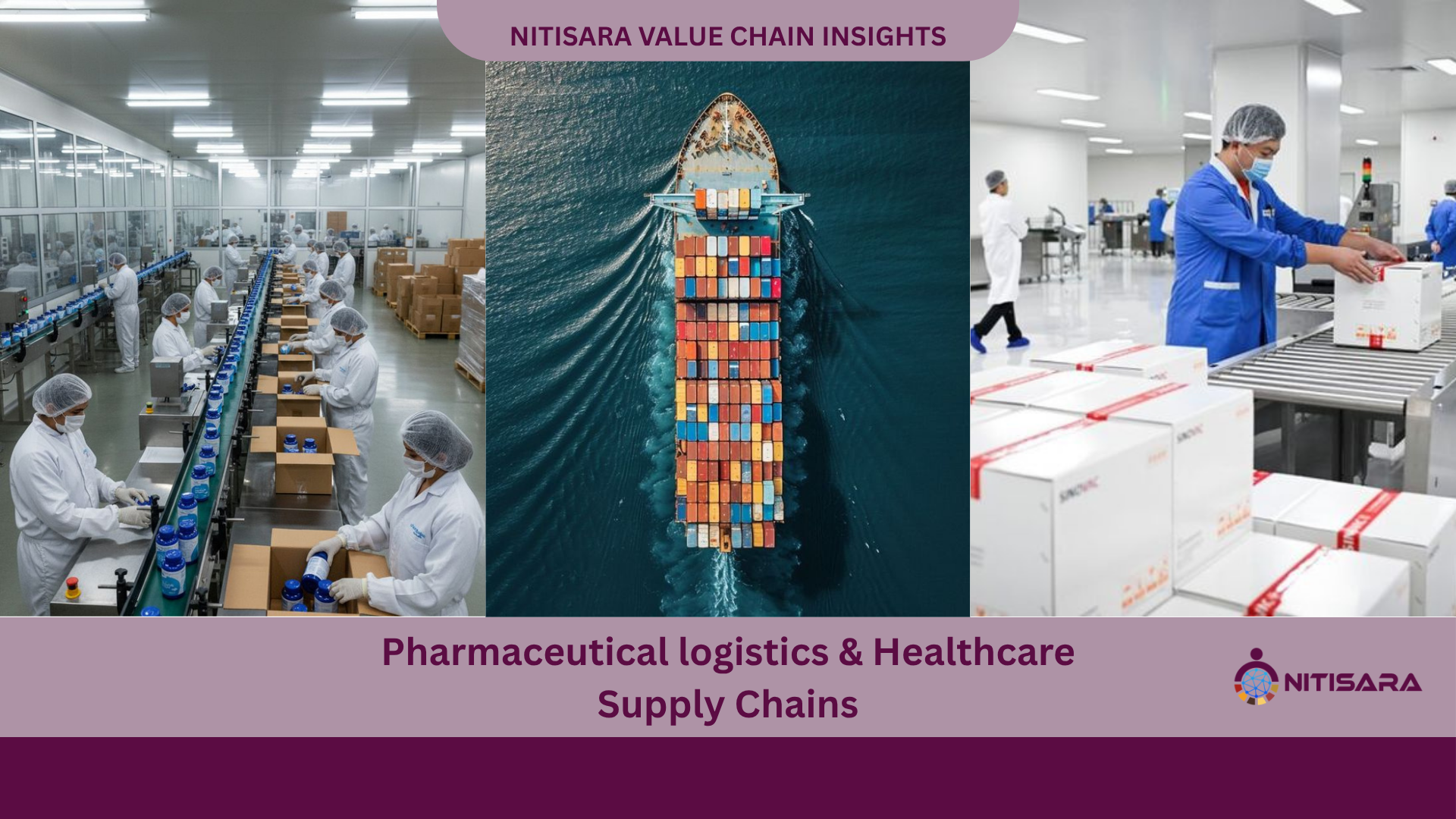
This piece looks at global pharmaceutical supply chains and the structural vulnerabilities that COVID-19 made impossible to ignore. Healthcare logistics has evolved from a back-office function into a strategic priority, and the ability to move medicines safely, quickly, and compliantly is now as important as the ability to manufacture them. It covers API dependency, cold-chain transformation, regulatory compliance, and the policy reforms shaping India’s role in the global pharmaceutical value chain, and asks why the world’s medical supply is so concentrated and what genuine resilience in healthcare logistics actually requires.
As of mid-2025, the U.S. FDA reported approximately 270 active drug shortages, with API shortages alone accounting for 42% of drugs unavailable globally in 2024. Over 70% of healthcare organizations experienced significant supply chain disruptions between 2020 and 2022. India, the world’s third-largest pharmaceutical producer by volume, supplies 20% of global demand for generic medicines and provides over 40% of all generic drugs consumed in the United States. What happens inside India’s pharmaceutical supply chain is a global public health question, not a domestic industrial matter.
The COVID-19 pandemic did something that years of industry reports could not: it made the risk in the pharmaceutical supply chain visible to everyone. Hospitals ran out of ventilator components. Countries scrambled for PPE. Antibiotic supplies tightened as lockdowns disrupted shipping routes. Governments that had assumed global trade would always deliver found themselves unable to guarantee the supply of medicines their populations needed right now.
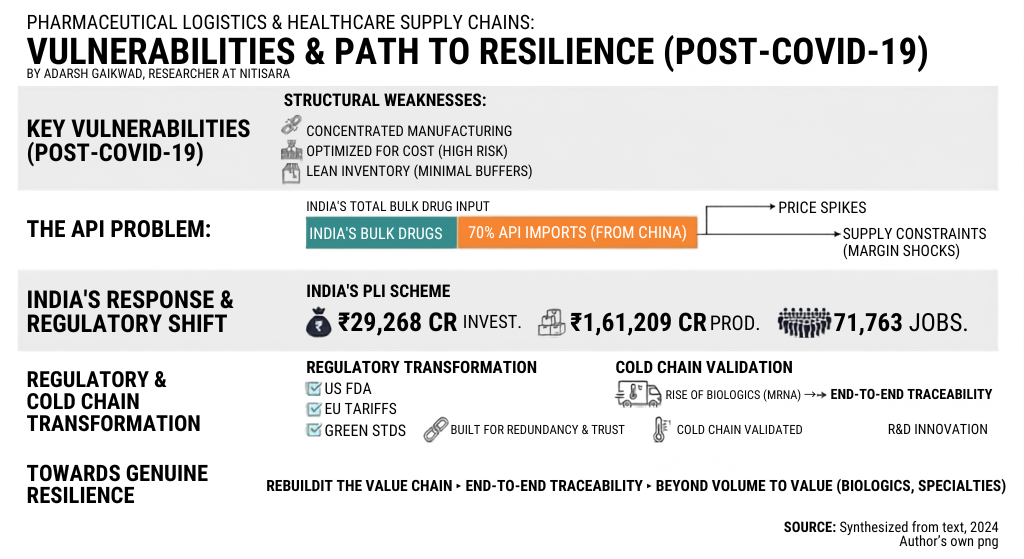
The root cause was a structure that had been quietly building for decades, not a single catastrophic event. The global pharmaceutical supply chain had been optimized relentlessly for cost. Manufacturing was concentrated in the lowest-cost locations. Inventory was kept lean. Single-source suppliers were tolerated because they were cheap. When any part of this structure was stressed, the system had no buffer to absorb it. The OECD’s 2024 report on securing medical supply chains found that pre-existing shortages of essential medicines were sharply exacerbated by the pandemic precisely because the chain had no built-in redundancy.
An Active Pharmaceutical Ingredient, or API, is the part of a medicine that actually does the therapeutic work. Without the right API, a formulation cannot be manufactured. And for much of the past two decades, API production has been concentrated in China to a degree that most of the world is only now fully coming to terms with.
India depends on China for approximately 70% of its bulk drug and intermediate imports. This means that much of what India manufactures and exports as finished pharmaceuticals, including the generic drugs that the U.S. and U.K. rely on heavily, still contains Chinese raw materials at some point in the chain. Sourcing from India does not automatically solve the underlying dependency. It shifts it one step upstream while leaving the structural vulnerability intact. When Chinese API prices spiked during the pandemic, Indian manufacturers absorbed margin shocks. When export restrictions tightened, production schedules slipped. The industry had cornered itself.
The Government of India’s response was the Production Linked Incentive scheme for bulk drugs and key starting materials, launched in 2020 with an outlay of ₹6,940 crore for critical APIs and a broader ₹15,000 crore allocation for the pharmaceutical sector. The objective wasn’t simply to manufacture more drugs — it was to rebuild the upstream end of the value chain that India had allowed to atrophy.
The early results are meaningful. As of March 2025, the PLI scheme has stimulated domestic production of 38 critical APIs that were previously almost entirely imported, including essential molecules like Penicillin G, Clavulanic Acid, Atorvastatin, and Metformin. The PLI scheme for bulk drugs has drawn actual investment of ₹29,268 crore, generated production worth ₹1,61,209 crore, and created 71,763 jobs. Three Bulk Drug Parks are being developed in Gujarat, Himachal Pradesh, and Andhra Pradesh, designed as cluster-based manufacturing ecosystems in which shared infrastructure lowers production costs and logistics integration delivers efficiencies of 15 to 20 percent compared to standalone facilities. Import substitution of approximately ₹2,192 crore has already been recorded. These are early but real signals that the strategy is beginning to work.
India’s pharmaceutical exports face a different kind of supply chain challenge at the other end of the value chain: regulatory compliance. The Indian pharmaceutical market is currently valued at approximately $50-$58 billion and is projected to reach $130 billion by 2030. Sustaining that trajectory requires maintaining access to the regulated markets that pay premium prices: the United States, the European Union, Japan, and the United Kingdom. And those markets are tightening their requirements.
The U.S. FDA has been increasing the frequency and depth of inspections of Indian manufacturing facilities. The European Union introduced a 23% tariff on API imports from manufacturers that fail to meet green manufacturing standards, creating an estimated €380 million in additional annual costs for Indian API producers. Serialization mandates, nitrosamine impurity testing, and cold chain validation requirements are all raising the bar for what counts as compliant pharmaceutical logistics. Regulatory compliance in this sector is now a supply chain architecture decision, not a documentation exercise. Companies that cannot demonstrate end-to-end traceability, from raw material origin through to distribution, are not meeting the standard regulators now expect.
The rise of biologics, vaccines, and gene therapies has fundamentally changed what pharmaceutical logistics must deliver. Traditional small-molecule drugs are relatively forgiving of temperature variation. Biologics, monoclonal antibodies, and mRNA-based medicines are not. A single temperature excursion during transit can render a batch of insulin or a vaccine vial clinically ineffective, with no visible sign of degradation. The patient receives a product that appears intact but does not work.
This is why cold chain management has moved from a logistics sub-function to a critical quality assurance process. Regulatory agencies now expect sponsors to validate temperature control at every node in the distribution network, from the manufacturing site to the wholesaler to the dispensing pharmacy. For India, this has implications that go well beyond export logistics. The domestic distribution of temperature-sensitive medicines across a country of 1.4 billion people, with extreme climate variation and uneven infrastructure, is one of the most complex cold chain challenges in the world. The Indian government’s investments in cold chain infrastructure under PMMSY and related schemes are beginning to address this, but the coverage gap in Tier 2 and Tier 3 cities remains significant.
India’s pharmaceutical sector has a structural problem that its export numbers do not fully reveal. The country is the world’s largest provider of generic medicines by volume, but it captures a relatively small share of global pharmaceutical value. Generic drugs are priced competitively by definition. The high-margin end of the pharmaceutical market, including biologics, complex injectables, specialty medicines, and patented formulations, remains largely outside India’s current export basket.
Moving up the pharmaceutical value chain requires more than additional manufacturing capacity. It requires R&D investment, regulatory trust built through consistent compliance, and logistics infrastructure capable of handling temperature-sensitive, high-value products with zero tolerance for error. India’s API market is valued at approximately $14.77 billion in 2025 and projected to reach $22 billion by 2030. The Indian pharmaceutical market overall is on a steep growth curve. But the distance between current positioning and a genuine high-value pharmaceutical export strategy is measured in regulatory track records, R&D pipelines, and cold chain capability, not just production output.
Pharmaceutical supply chains are unlike any other. The product being moved is a medicine that a patient somewhere depends on, not a commodity or a consumer good. When that chain fails, the consequences show up as treatment delays, drug shortages, and in the most serious cases, lives — not just revenue. The lesson of the past five years is that the pharmaceutical supply chain needs to be built for resilience first and efficiency second, not the other way around. For India, the opportunity is significant: the PLI scheme is rebuilding API manufacturing capability, export volumes are growing, and regulatory frameworks are being strengthened. The challenge is to convert that momentum into a supply chain that is not just large but genuinely reliable, compliant, and capable of delivering medicines to the markets that need them, at the quality those markets demand.
The views expressed do not represent the company’s position on the matter. This is not AI-generated content. Stay informed through the Nitisara Platform and Blogs, and adapt to emerging trends to thrive in the competitive global marketplace. – https://nitisara.org/category/blogs-updates/