What is a Bill of Lading?
By admin
/ March 19, 2024
In the dynamic realm of international trade, the ‘bill of lading’ holds a pivotal role in ensuring the smooth transportation…
Read More

By Shakthi M, Researcher at NITISARA
Eighty per cent of world trade moves by sea, yet major trading blocs largely overlook the maritime insurance sector. Maritime insurance shapes which ships sail, which routes are viable, and which nations can access global commerce. This article explores the industry’s journey from Edward Lloyd’s Coffee House in 1688 to the London Market’s modern global influence. It also covers recent cases—such as the repricing of the Red Sea and sanctions on Russia—and assesses India’s shift from reliance on foreign insurers to building its own capacity.
Any disruption to maritime operations carries significant economic consequences. This is the context in which maritime insurance emerges as a critical institutional mechanism facilitating global trade. During the Red Sea crisis of 2023-24, Houthi militant attacks on commercial vessels forced shipping companies to reroute around the Cape of Good Hope, resulting in longer transit times and higher operational costs. War insurance premiums spiked, freight costs rose sharply, and global supply chains faced significant disruption. The crisis demonstrates that maritime insurance is not merely a form of compensation but rather plays a crucial role in determining where the trade flows, which routes are commercially viable, and how the global economy functions. From facilitating trade finance to enforcing sanctions and navigating international regulatory frameworks, maritime insurance is important in managing and distributing maritime risk. Institutes like Lloyd’s of London, Protection and Indemnity Clubs, and the International Maritime Organisation have shaped how maritime risk is assessed and distributed worldwide.
The origins of maritime insurance date back centuries before most modern financial instruments. In 1200 BC, Phoenician traders began risk-sharing practices amongst themselves, leading to the first formal marine insurance policy around 1350. By the 15th and 16th centuries, insurance-like agreements had emerged in Barcelona, Antwerp, and Amsterdam to protect capital amidst expanding maritime trade. The institutional formalisation of this practice is closely associated with England. In February 1688, Edward Lloyd’s Coffee House in Tower Street, London, was first recorded in the London Gazette. By the 1730s, Lloyd’s was emerging as the place for individual marine underwriting. Trade volumes and British imperial expansion led to the development of mutual insurance structures, as individual underwriting was limited. The North of England Steam Ship Insurance Association was one of the earliest Protection and Indemnity Clubs, which accounts for approximately 90% of the world’s P&I business today. The United Kingdom’s centuries-old institutional evolution has positioned it as a structural foundation of global maritime insurance.
London, as the global financial centre, began not with a single event. The foundations were laid when the Royal Exchange was established in 1571, and the Bank of England followed in 1694, providing stable currency, managing public debt, and creating the institutional trust necessary for large-scale financial activity. As a port city, London drew merchants from across Europe and became a centre of commerce. The British Empire accomplished what no rival could match: it made English law the default framework for international trade. Many post-colonial economies adopted their legal systems based on English law. The UK then became the world’s highest net exporter of financial services. In 1986, the British government deregulated the financial markets, which became known as “The Big Bang”. This allowed greater liberalisation, giving financial institutions room to expand and attract clients from around the globe. London held its position as the world’s top financial hub since the 1600s, and by the 1990s became Europe’s largest securities trading centre.
As a result of centuries of legal, institutional, and commercial architecture, London has dominated marine insurance for decades, establishing itself as the undisputed global centre. The Marine Insurance Act 1906, though drafted in England, has been adopted wholesale by jurisdictions across the world. When a cargo ship departs Singapore or a tanker is financed in Tokyo, the legal framework adjudicating that risk traces back to London’s Commercial Court. Built on this legal foundation is Lloyd’s of London, whose unique syndicate model pools capital from competing underwriters under one roof, providing specialist insurance services across over 200 countries and territories. The City of London further concentrates underwriters, brokers, maritime lawyers, P&I club managers, and ESG specialists within a single geography. The result is a self-reinforcing ecosystem that does not merely react to global risk but actively shapes it. London held approximately £130 billion out of the £1,494 billion global re/insurance market in 2024, with its speciality insurance share rising from 43% in 2022 to 45.4%, a trajectory that demonstrates how London’s structural advantages — legal authority, syndicate flexibility, and concentrated expertise continue to compound over time.
London Market’s share of global speciality insurance, 2010–2024.
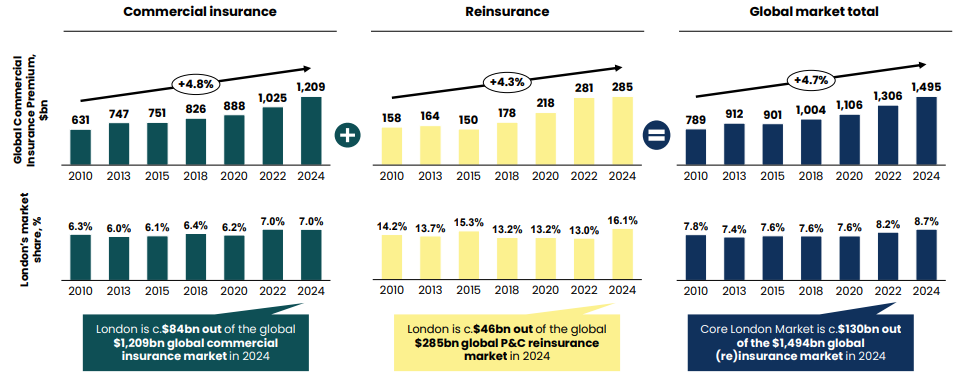
Source: London Market Group, London Matters 2026 Fact Base
Maritime insurance is an active governance mechanism that shapes behaviour at sea and enforces international order. At its regulatory level, the IMO sets the standards that determine whether a vessel is insurable at all. Its ISM Code, adopted under SOLAS Chapter IX, mandates that every ship-owner establish a Safety Management System covering navigation, emergency response, and environmental controls. Non- compliance makes a vessel effectively uninsurable, meaning IMO’s reach is enforced not just by flag states but by the insurance market itself.
Liability risk is pooled through P&I Clubs – mutual associations that are central to how shipping absorbs catastrophic loss. The International Group of P&I Clubs covers approximately 90% of the world’s ocean-going tonnage, insuring crew claims, cargo damage, pollution liability, and wreck removal. At the insurer level, the Solvency II Directive (2009), adopted in the wake of the financial crisis, harmonised insurance regulation across the EU and addressed supervisory weaknesses that the crisis had exposed. In the UK, a twin-peak model operates through the Financial Conduct Authority and the Prudential Regulation Authority.
Following the 2022 Russian invasion of Ukraine, this framework’s geopolitical power was clearly evident. Lloyd’s Market Association’s Joint War Committee added Ukrainian and Russian waters in the Black Sea and Sea of Azov to its list of war, piracy, and terrorism risk zones. The cost of war risk on Black Sea voyages has skyrocketed to 7%. Western P&I Clubs simultaneously withdrew cover from sanctioned Russian entities, coordinating with OFSI and OFAC to enforce sanctions through insurance denial. This proves that withdrawing cover can shut down a shipping route and have a geopolitical impact.
India handles around 95% of its international trade by sea, yet the marine insurance sector remains underdeveloped. Total maritime insurance gross direct premiums stood at over ₹5,000 crores (~$600 million) in FY2024. Indian shipping depends heavily on the International Group of P&I Clubs for cover against oil spills, cargo damage, and crew injury, leaving trade exposed whenever global insurers pull back during geopolitical crises. Around 80% of Indian seafarers serve on foreign-flagged ships covered by foreign P&I clubs. This means the crew faces stranding and wage delays the moment those clubs restrict coverage in high-risk zones. The Hormuz crisis impacted 23,000 Indian seafarers across the Gulf, with 768 crew members stranded on 28 Indian-flagged vessels.
The Insurance Amendment Act (2025) allows 100% FDI in Insurance and explicitly expands coverage into the marine sector. More decisively, India launched the Bharat Maritime Insurance Pool (BMIP) in May 2026, a $1.5 billion sovereign-backed pool with a government guarantee of ₹12,980 crores, administered by GIC Re (General Insurance Corporation of India). The pool covers all four critical categories of maritime risk: Hull and Machinery, Cargo, P&I, and War Risk for Indian-flagged vessels and any vessel trading to or from Indian ports. India is on track to become the world’s third-largest economy by 2030. IRDAI projects India will be the sixth-largest insurance market globally within a decade. India’s maritime story is no longer just about ports and tonnage — with sovereign insurance capacity, the country is finally building the financial infrastructure to match its trade ambitions.
Maritime Insurance is the framework on which global trade is built. This article has traced three dimensions of that power: the historical scope that made London structurally irreplaceable, the institutional architecture and India, a nation building its sovereign capacity. The Red Sea crisis, the Russian sanctions, and the Hormuz stranding of seafarers are each an indicator that maritime insurance effectively controls international commerce. It is necessary to understand who holds this veto, how it is exercised, and who is working to redistribute it. It is a question with real consequences for every nation whose prosperity depends on the sea.
The article has not used an AI tool to generate article-related content. The views expressed do not represent the company’s position on the matter. Stay informed through the Nitisara Platform and Blogs, and adapt to emerging trends that are poised to thrive in the competitive global marketplace. – https://nitisara.org/category/blogs-updates/ .
https://repository.graduateinstitute.ch/record/300020/files/Financial_Developments_in_London.pdf
https://unctad.org/meeting/launch-review-maritime-transport-2023
https://riskandinsurance.com/brief-history-marine-insurance/
https://lmg.london/wp-content/uploads/2026/02/London-Matters-2026-Fact-Base-VF-Web.pdf
https://www.lloyds.com/about-lloyds/our-market/lloyds-market
https://www.ukchamberofshipping.com/policy/prosperity/the-value-of-uk-shipping
https://www.ibef.org/industry/insurance-sector-india
https://www.investopedia.com/how-london-became-the-world-s-financial-hub-4589324