What is a Bill of Lading?
By admin
/ March 19, 2024
In the dynamic realm of international trade, the ‘bill of lading’ holds a pivotal role in ensuring the smooth transportation…
Read More

By Adarsh Gaikwad, Researcher at NITISARA
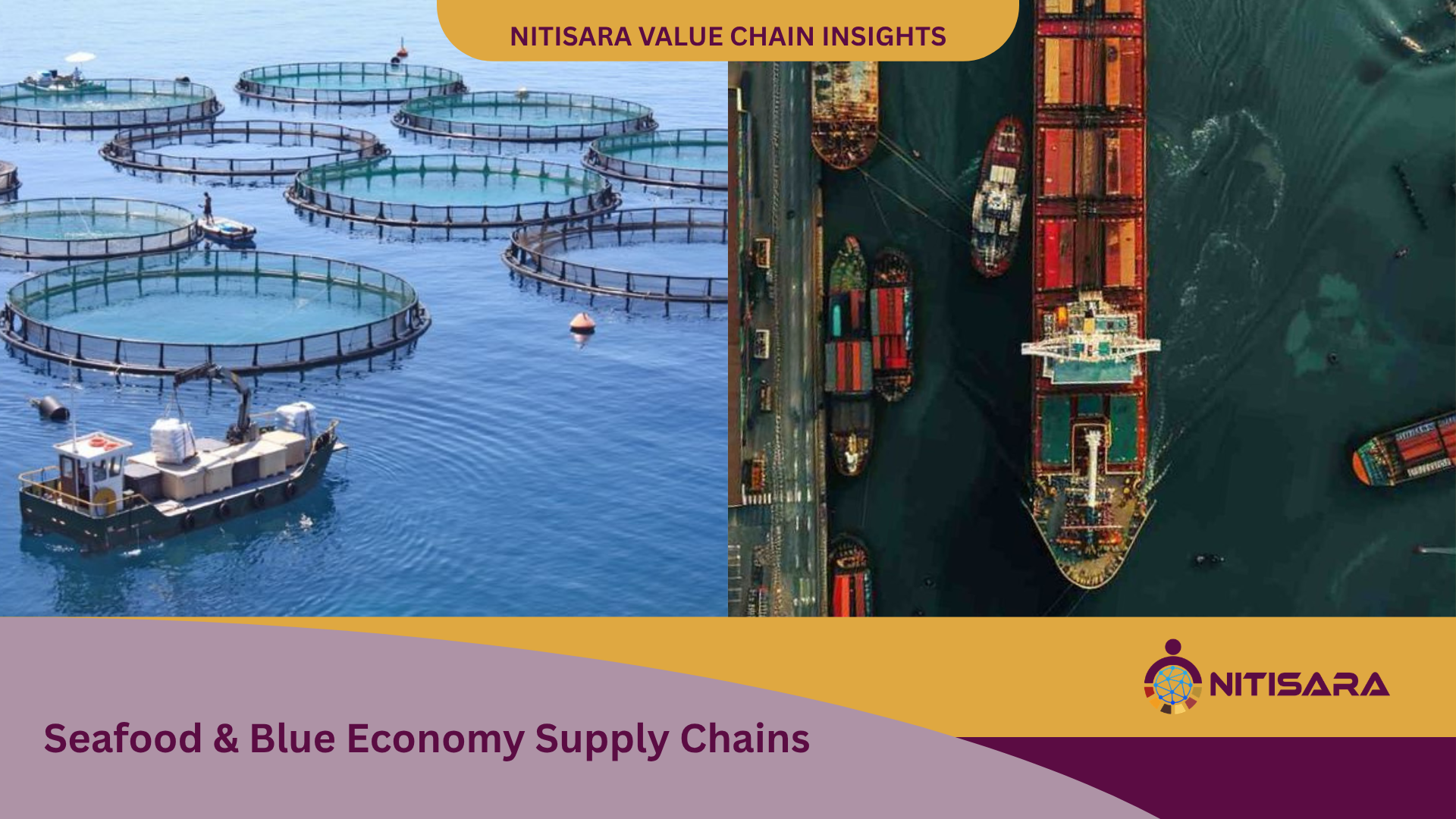
This piece looks at global seafood trade and the growing pressure on supply chains to prove where their fish actually comes from. The blue economy is reshaping coastal livelihoods, export compliance frameworks, and the infrastructure needed to move seafood from the ocean to the shelf without compromising quality, legality, or value. It covers supply chain resilience in the fisheries sector, the challenge of IUU fishing, and the digital and physical infrastructure that determines whether a seafood exporter succeeds or fails in global markets, and asks why so much seafood reaches consumers through opaque supply chains, and what it takes to build the transparency that global buyers increasingly demand.
Global seafood trade is worth more than the combined trade value of beef, pork, and poultry. Yet up to 20% of all wild-caught fish enter global markets through illegal, unreported, and unregulated fishing, costing the global economy between $15 billion and $36.4 billion every year. India, the world’s second-largest fish producer, exported a record ₹73,890 crore ($8.46 billion) worth of seafood in FY2025–26. The opportunity is real. So is the risk of losing it to a supply chain that cannot prove what it is selling.
When a consumer in Europe or America picks up a packet of frozen shrimp, they rarely think about where it came from. But behind that packet is a supply chain that can span five or six countries, encompassing fishing vessels, landing sites, processing factories, cold storage facilities, freight forwarders, and customs clearance agents. At any point in that chain, the trail of a fish can go cold. Not just figuratively, but literally.
Illegal, unreported, and unregulated (IUU) fishing is one of the most underreported problems in global trade. It accounts for roughly one in five fish caught globally. The damage it causes goes beyond revenue losses. It depletes fish stocks that coastal communities depend on for their livelihoods. It undercuts honest fishers who follow the rules. It introduces products into global food supply chains without safety verification, species guarantees, or records of how they were caught. And it is inherently a supply chain failure, one that starts at sea and ends at a supermarket shelf because nobody checked the paperwork in between.
The world’s largest seafood import markets are no longer treating traceability as optional. The United States Food Safety Modernization Act now requires traceability documentation for seafood. Japan’s Fishery Products Distribution Act mandates the keeping of verified origin records. The European Union’s catch certification scheme requires every shipment to carry documentation proving the fish was legally caught, and countries that fail to meet this standard risk being red-carded, effectively barred from one of the world’s richest consumer markets.
Vietnam learned this the hard way. The EU issued a yellow card warning to Vietnam’s seafood industry in 2017 over concerns about IUU fishing, and the country spent years restructuring its fisheries governance and traceability systems to comply with the warning. The economic stakes were enormous: the EU is one of Vietnam’s largest seafood export markets. Export compliance is now a market access condition, not just a regulatory requirement, in the seafood sector, and for exporters in developing economies with large fishing fleets, it is becoming the single most important non-tariff barrier they face.
The traditional method of tracking fish through paper-based catch certificates and manual inspections cannot handle the scale or complexity of modern seafood supply chains. A single processing facility in a major exporting country might receive product from dozens of fishing vessels in a single day. Cross-referencing that volume manually is not a realistic expectation.
Digital platforms are changing this. Electronic catch documentation systems, blockchain-based traceability tools, and interoperable data platforms are enabling the tracking of a fish from the moment it is caught to the moment it is sold. The Global Dialogue on Seafood Traceability, established by WWF and the Institute of Food Technologists, has developed a common data language that enables different national traceability systems to communicate with one another. Indonesia, one of the world’s largest fishing nations, is aligning its national traceability infrastructure with this global standard. The practical effect is significant: a buyer in Germany can verify the origin of a shipment from Indonesia without having to trust a paper trail that passes through six intermediaries. Cold logistics is the physical counterpart to this digital layer. A verified, traceable supply chain that cannot maintain temperature integrity between the fishing vessel and the consumer is still failing. For perishable seafood products, cold-chain failure is the most common cause of rejection during export compliance inspections.
India has more at stake in this transition than almost any other country. With an 11,099-kilometer coastline, an Exclusive Economic Zone covering over 2 million square kilometers, and fish production that has more than doubled in the past decade from 95.79 lakh tonnes to 197.75 lakh tonnes, the country is already a global seafood powerhouse. The sector sustains nearly nine million livelihoods. It contributes 7.43% of agricultural GVA. And it is growing rapidly, aiming to reach ₹1 lakh crore in seafood exports by 2030.
The government’s Pradhan Mantri Matsya Sampada Yojana has committed significant resources to building the infrastructure layer that export growth requires: 730 cold storages and ice plants, 26,348 fish transport facilities, and modernized harbor infrastructure across coastal states. Frozen shrimp alone, primarily Vannamei and Black Tiger varieties, generated ₹49,038 crore in FY2025–26, accounting for 66.5% of total seafood export value. The U.S. and China are India’s two largest markets by value and volume, respectively. The EU, Japan, and Southeast Asia are priority diversification targets as India works to reduce its exposure to any single buyer market, particularly following new U.S. tariff pressures in 2025.
Despite record export numbers, India’s seafood sector has a structural problem that the numbers do not fully reveal. Only about 15% of seafood produced in India undergoes any form of value-added processing before export. The rest leaves as a raw or minimally processed product, meaning the country captures the early, lower-margin portion of the value chain and leaves the premium end to processors in importing countries.
The Indian Cold Chain for Seafood and Agro Exports Market is currently valued at approximately $2.3 billion and is growing steadily. But cold chain coverage remains uneven, particularly for small-scale coastal fishers who land catch at informal sites without access to adequate ice, chilled transport, or quick access to processing facilities. Post-harvest losses in the sector remain significant. Every kilogram of fish lost after landing is a failure of the value chain to deliver what was caught, not just a revenue loss for the fisher, and in a sector where margins are already thin, those losses compound quickly.
The coastal economies of Andhra Pradesh, Gujarat, Tamil Nadu, Kerala, and Odisha, which together account for the overwhelming majority of India’s seafood exports, are the places where cold logistics investment has the most direct impact on livelihoods. A fisherman in Nellore who can get his shrimp into a chilled truck within two hours of landing earns more per kilogram than one whose catch sits on ice in the sun for six hours before a vehicle arrives.
The global seafood supply chain is at a turning point. Buyers in major markets are demanding proof of legality, origin, and safety in ways that were not standard practice five years ago. IUU fishing, traceability gaps, and cold chain failures are trade risks now, not just environmental or logistical problems, risks that can cut off market access overnight. The countries and companies that invest in transparent, digitally enabled, temperature-controlled supply chains are building something more durable than export volume alone: trust with buyers who control the world’s most valuable markets.
For India, the trajectory of the blue economy is genuinely exciting. The production base is large, policy support is strong, and export infrastructure is improving. The challenge now is to move up the value chain: from bulk frozen shrimp to processed, branded, and traceable seafood products that command better prices and stronger buyer relationships. That transition won’t happen through fishing alone; it will happen through supply chains that can prove, at every step, that what is in the box is exactly what it claims to be.
The views expressed do not represent the company’s position on the matter. This is not AI-generated content. Stay informed through the Nitisara Platform and Blogs, and adapt to emerging trends to thrive in the competitive global marketplace. – https://nitisara.org/category/blogs-updates/
https://www.insightsonindia.com/2026/04/07/advancing-indias-fisheries-sector/
https://www.ift.org/publications/brain-food-blog/2025/advancing-safety-in-the-seafood-supply-chain/
https://www.worldwildlife.org/our-work/oceans/building-a-transparent-seafood-supply-chain/
https://www.stimson.org/2024/fight-iuu-fishing-with-the-tools-of-today-and-tomorrow/
https://www.pib.gov.in/PressNoteDetails.aspx?NoteId=156127&ModuleId=3®=3&lang=1
https://www.kenresearch.com/india-cold-chain-for-seafood-agro-exports-market