What is a Bill of Lading?
By admin
/ March 19, 2024
In the dynamic realm of international trade, the ‘bill of lading’ holds a pivotal role in ensuring the smooth transportation…
Read More

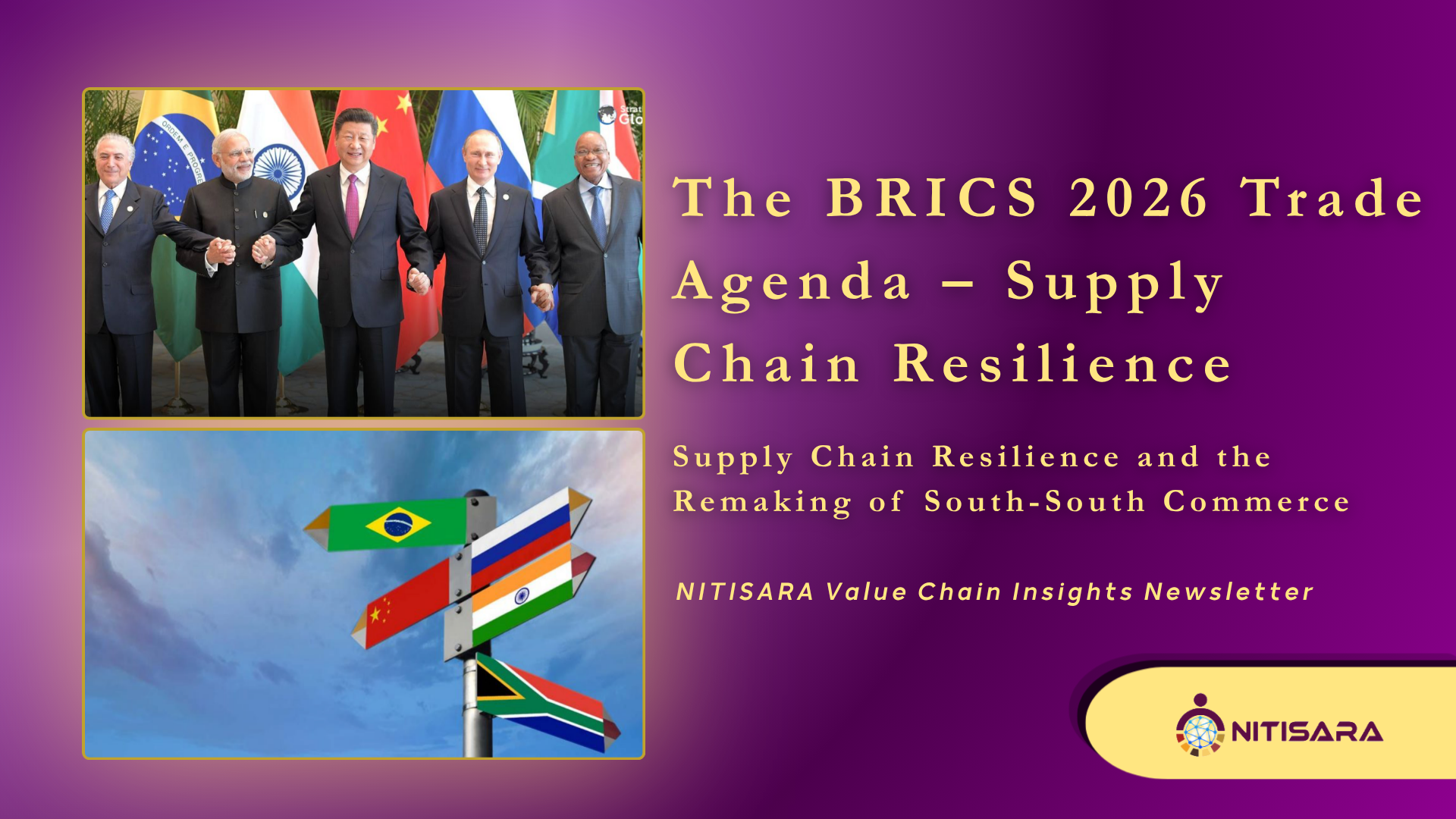
“As the BRICS bloc expands its global footprint, its trade focus has shifted toward building mutual insulation from external disruptions. Under India’s 2026 chairmanship, the BRICS agenda is centred on supply chain resilience, alternative payment networks, and logistics integration across the Global South. This piece previews the 2026 BRICS trade agenda, examining how the alliance is attempting to redefine south-south trade corridors, and what the logistics industry needs to understand about the shift underway.”
By Nirali Sharma, Intern, NITISARA.
“Intra-BRICS trade has surpassed $1 trillion, the bloc now accounts for nearly 40% of global GDP, and BRICS Pay, a cross-border settlement system alternative to SWIFT. Yet the gap between ambition and architecture remains wide.”
BRICS is no longer the four-country economic discussion forum it started as in 2009. With the formal expansion that admitted Egypt, Ethiopia, Iran, UAE, and Indonesia as full members in January 2025, the bloc now spans 10 nations representing approximately 45% of the global population, 39.7% of global GDP, and, crucially for the logistics industry, an extraordinary concentration of natural resources, manufacturing capacity, and energy supply. The grouping now accounts for 40% of global trade. Intra – BRICS merchandise trade has expanded more than 13 – fold since 2003, reaching $1.17 trillion in exports in 2024. Yet the same UNCTAD analysis that surfaces this growth also delivers a sobering caveat: despite accounting for 27% of global output, 24% of exports, and 22% of FDI inflows, intra – BRICS trade represents only 5% of global trade, highlighting substantial untapped potential.
The gap between the bloc’s economic weight and its trade integration is precisely the problem that the 2026 agenda is designed to address. Under India’s chairmanship, with the theme “Building Resilience and Innovation for Cooperation and Sustainability”, the priorities are clear: resilient supply chains, alternative payment infrastructure, logistics corridor development, and digital public infrastructure. The 18th BRICS Summit, scheduled for New Delhi in August or September 2026, is expected to formalise commitments across all four areas. For the global logistics industry, the implications are direct and material.
The cumulative disruption of the past few years, the COVID pandemic, the Red Sea crisis, sanctions regimes, export controls, and conflicts in Eurasia and the Strait of Hormuz, has exposed the fragility of legacy trade routes built around Western markets and financial systems. The WEF notes that roughly 15% of trade flows were disrupted due to geopolitical tensions and climate events in 2024, with losses incurred of roughly 7% of global GDP. For BRICS members, many of which have experienced direct exposure to sanctions, export controls, or chokepoint disruptions, supply chain resilience is not an abstract policy objective, it is an operational necessity. The ORF-DP World roundtable “Building Resilience Through Trade Corridors” at Davos in January 2025 identified key vulnerabilities in current BRICS supply chains: connectivity gaps, scarce raw materials, the need for new mineral corridors, and trade facilitation bottlenecks, and made the case for a common logistics platform as the structural response. The 2026 agenda reflects this diagnosis. The emphasis is on building redundancy into south-south trade corridors, creating alternative routes, alternative financial rails, and alternative institutional frameworks that reduce the ability of any single external actor to disrupt trade flows within the bloc.
The most operationally significant development in BRICS’ 2026 trade agenda is the live deployment of BRICS Pay, a cross-border settlement platform integrating national payment systems including China’s CIPS, India’s UPI, Brazil’s Pix, and Russia’s SPFS, designed to enable local-currency trade settlement without SWIFT intermediation.
Intra-bloc local-currency trade has surpassed 67%, and full deployment of BRICS Pay is targeted at the 2026 India summit. The RBI has submitted a proposal to place the linking of BRICS member CBDCs, digital ruble, digital yuan, and digital rupee, on the 2026 summit agenda, creating a system where a trader in India can pay a supplier in Brazil using their respective CBDCs, eliminating the need for a dollar intermediary and reducing transaction costs.
What has advanced is a cross – border payments agenda: local-currency settlement in some corridors, technical work on payment-system interoperability, and continued discussion under India’s 2026 chairmanship. The dollar still dominates global FX trading at 88%, and its reserve share has declined from over 70% in 2000 to below 57% in 2026. BRICS Pay does not aim to immediately replace the dollar-centred framework, but it is building parallel payment rails that gradually reduce dependency, with direct implications for how trade across BRICS corridors is invoiced, settled, and financed. For logistics and supply chain operators working across BRICS trade lanes, this matters practically: payment system fragmentation adds transaction cost and settlement risk. A functioning alternative payment infrastructure that enables faster, cheaper local – currency settlement between BRICS members reduces one of the most persistent friction points in south – south trade.
The development of transport corridors within BRICS represents an attempt at a fundamental transformation of logistics in the Global South. Key emerging corridors include: the Northern Sea Route (the shortest path between Europe and Asia); the International North – South Transport Corridor (INSTC) linking Russia with Iran, India, the Gulf states and South Asia; the Transoceanic corridor proposed by China and Brazil; and the Primorye – 2 International Transport Corridor connecting northeast China with Russian Far East ports.
The INSTC is the most commercially advanced of these. Stretching from India through Iran to Central Asia and onward into Eastern Europe, Eurasia, and Russia, it provides an alternative multimodal route that reduces transit times between Indian ports and Russian and Central Asian markets compared to the traditional Suez Canal routing. With UAE now a full BRICS member, the corridor’s Gulf segment gains additional commercial depth, connecting Indian Ocean trade flows to the North-South axis through the Arabian Peninsula.
Sectors including logistics and infrastructure, green energy, digital technologies, and critical minerals represent the priority areas for intra-BRICS collaboration identified in the ORF-DP World analysis. The New Development Bank (NDB), BRICS’ own multilateral development institution, is increasingly directing financing toward logistics and connectivity infrastructure in member states, including port development, rail corridors, and cross-border customs harmonisation projects.
| Corridor / Initiative | Countries Involved | Mode | Strategic Purpose |
| INSTC (North-South Transport Corridor) | India, Iran, Russia, Central Asia | Multimodal (rail, road, sea) | Alternative to Suez; connects Indian Ocean to Eurasia |
| Northern Sea Route | Russia, China | Maritime | Shortest Europe-Asia route; Arctic shipping expansion |
| China-Brazil Transoceanic Corridor | China, Brazil, Peru (Chancay) | Maritime + rail | Pacific-Atlantic Latin America integration |
| BRICS-Africa Corridor | NDB + African members (Ethiopia, Egypt) | Multimodal | Raw material to value-added manufacturing supply chains |
| Primorye-2 Corridor | China, Russia (Primorsky Krai) | Rail + maritime | Northeast China access to Pacific ports |
India’s role in the 2026 BRICS agenda is the most strategically complex of any member. As chair, India has defined the agenda, but its relationship with the bloc’s dominant member, China, remains structurally complicated by border tensions, trade imbalances, and competing infrastructure visions across South and Central Asia.
New Delhi’s emphasis on resilience, innovation, cooperation, and sustainability suggests an attempt to shape BRICS around practical economic cooperation, digital public infrastructure, energy security, and resilient supply chains rather than ideological bloc politics. This is a deliberate framing: India wants a BRICS that delivers practical logistics and trade infrastructure benefits, the INSTC, the NDB’s financing pipeline, payment system interoperability via UPI integration, without committing to a bloc identity that constrains its strategic flexibility with Western partners.
For the logistics industry, India’s position matters enormously. India is simultaneously investing in Vizhinjam as a transshipment hub, expanding the Sagarmala port – led development programme, building out the INSTC as an alternative trade corridor, integrating UPI into BRICS Pay, and positioning Indian ports and logistics infrastructure as nodes on multiple south-south trade routes. The coherence of these investments, or their fragmentation across competing bilateral and multilateral frameworks, will significantly determine how much of the BRICS logistics integration agenda translates from summit declaration into operational supply chain reality.
The BRICS 2026 trade agenda is not primarily an ideological project, it is a practical response to supply chain fragility, payment system vulnerability, and logistics integration gaps that impose real costs on trade across the Global South. For the logistics industry, three developments warrant close attention.The expansion of local – currency settlement through BRICS Pay reduces foreign exchange transaction costs on intra – BRICS corridors and removes settlement risk from dollar-intermediated transactions. Logistics operators and freight forwarders working across China – India, India – UAE, Brazil – China, or Russia – India trade lanes will encounter this shift in how their customers structure trade finance and payment terms.
The corridor infrastructure investments, INSTC, Northern Sea Route, the Chancay port in Peru, and NDB – financed connectivity projects, are creating new routing options for cargo that previously had only one or two viable paths. For supply chain planners, this expands the set of viable alternatives for resilience routing, particularly for bulk commodities, energy products, and critical minerals that move in large volumes between BRICS members.”
And the gap identified by UNCTAD, that intra – BRICS trade represents only 5% of global trade despite the bloc’s 27% share of global output, represents the commercial opportunity that improved logistics integration, harmonised customs procedures, and functioning payment infrastructure could unlock. By 2024, 26 bilateral BRICS trade flows already exceeded $5 billion, but significant corridors remain underdeveloped due to logistics gaps rather than demand gaps.
BRICS’ 2026 ambition is large: a trade bloc that is simultaneously an alternative financial system, a logistics corridor network, and a development financing institution for the Global South. The gap between that ambition and current reality, in payment system maturity, corridor infrastructure completion, and policy harmonisation, is equally large.
The data remains the bloc’s strongest selling point: BRICS now accounts for approximately 40 – 50% of global GDP and represents roughly half of the world’s population. Intra – bloc trade has surpassed the $1 trillion milestone. But as analysts have noted, these macro wins mask a more difficult micro reality: the supply chains, logistics platforms, and trade finance mechanisms that would allow BRICS members to actually trade more with each other, rather than through Western intermediaries and infrastructure, are still being built.
The 2026 summit in New Delhi is an opportunity to close that gap. Whether it does will depend less on declarations than on the operational progress of BRICS Pay, the INSTC, the NDB’s project pipeline, and the logistics integration agenda that India has put at the centre of its chairmanship. For the global logistics industry, the shift is already real enough to plan around, even if its full architecture is still under construction.
The views expressed do not represent the company’s position on the matter. This article does not represent AI-generated content. Stay informed through the Nitisara Platform and Blogs, and adapt to emerging trends that are poised to thrive in the competitive global marketplace.- https://nitisara.org/category/blogs-updates/.