What is a Bill of Lading?
By admin
/ March 19, 2024
In the dynamic realm of international trade, the ‘bill of lading’ holds a pivotal role in ensuring the smooth transportation…
Read More

By Tejas Siddalingeshwar, Researcher, NITISARA
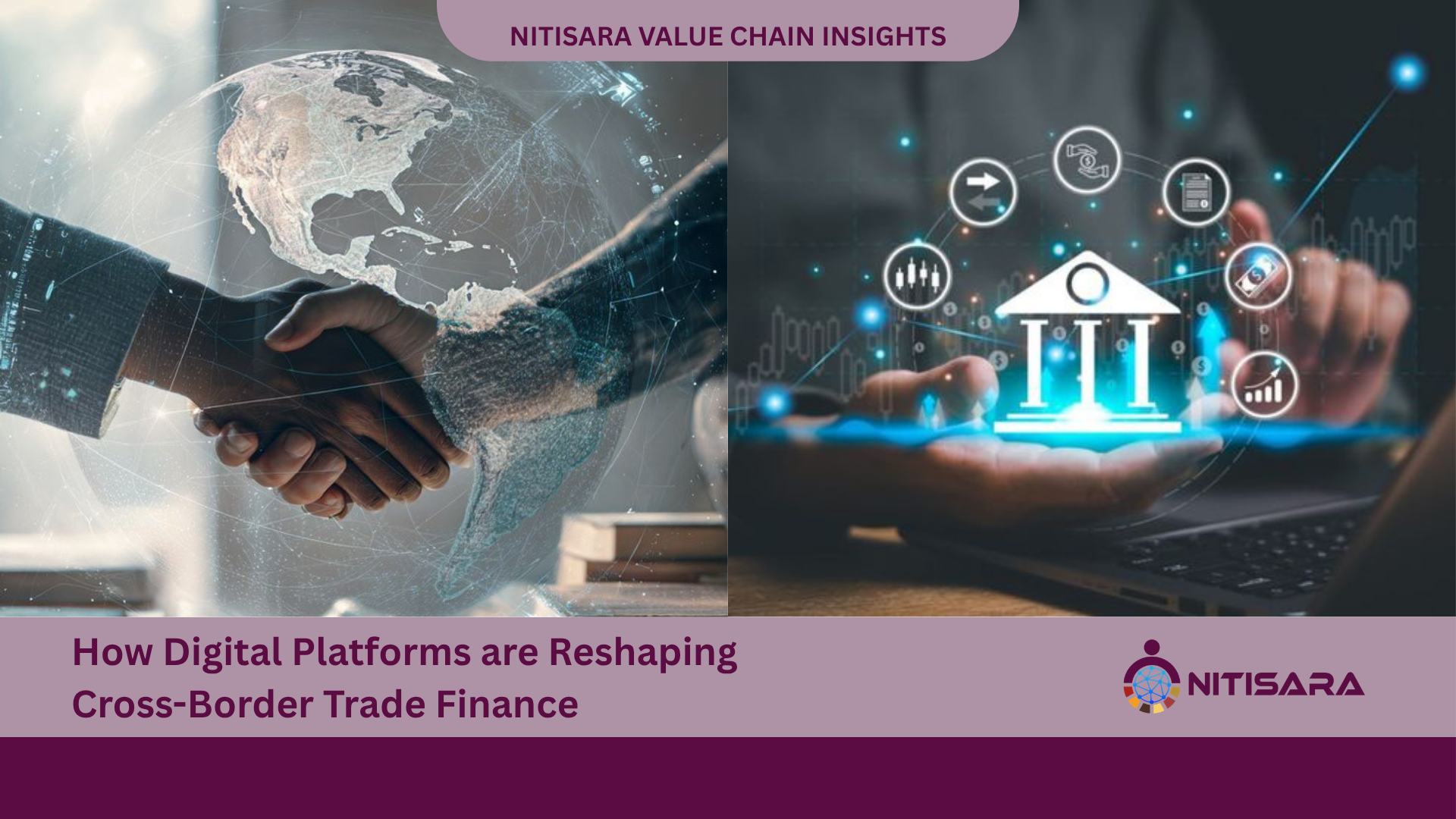
This article studies how digital platforms, electronic transferable records, electronic bills of lading, smart contracts, and blockchain-enabled records are reshaping trade finance. It argues that the biggest productivity gain comes from linking logistics data, legal title, invoice validation, and financing in one trusted workflow. The technology matters, but the deeper change is institutional: trade finance becomes a data problem instead of a paper custody problem.
Introduction
Cross-border trade finance has long been constrained by paper documents, fragmented verification, manual compliance checks, and slow movement of title. Digital trade finance platforms are changing that architecture. Their value is not limited to faster forms. They alter the legal, operational, and financial conditions under which banks trust a shipment, exporters receive liquidity, and buyers confirm performance.
The Old Bottleneck Was Paper Control
Traditional trade finance relies on documents that represent goods, payment rights, and contractual performance. Bills of lading, invoices, insurance certificates, inspection certificates, letters of credit, and customs documents move between exporters, importers, banks, carriers, and regulators. Each handoff creates delay, fraud risk, courier cost, and reconciliation work.
A paper bill of lading is especially important because it can function as receipt, contract evidence, and document of title. Digitizing ordinary PDFs does not solve this legal problem. The system needs a reliable way to establish singular control over an electronic record so that the same document cannot be duplicated and pledged twice.
Electronic Transferable Records Change the Legal Base
The UNCITRAL Model Law on Electronic Transferable Records addresses this problem by creating functional equivalence between paper transferable documents and electronic records. The principle is not that every trade document becomes a blockchain token. The principle is that a reliable electronic method can perform the legal functions of writing, signature, possession, control, and transfer.
Trade-finance layer Paper-era weakness Digital-platform improvement Document title Physical possession is slow and courier-dependent. Electronic transferable records can establish control digitally. Invoice verification Banks manually match inconsistent documents. Platforms can validate fields against shipment and purchase-order data. Compliance Screening is repeated by multiple parties. Shared data rails reduce duplicate checks while preserving controls. Financing trigger Credit starts after document acceptance. Validated milestones can support earlier financing. Dispute handling Missing or inconsistent paper documents create ambiguity. Audit trails preserve version history and approvals. Source: Self-sourced synthesis based on UNCITRAL MLETR, ICC Digital Standards Initiative, and DCSA electronic bill of lading standards.
Blockchain Is Useful Only Where It Solves Trust
Blockchain is often over-sold in trade finance. A distributed ledger does not automatically create legal validity, buyer demand, bank adoption, or clean data. Its use is strongest where parties need a shared, tamper-evident record across institutions that do not fully trust one another. If a centralized registry with clear legal recognition works better, the economics may favor centralization.
Smart contracts also need a sober interpretation. In trade finance, a smart contract is not a magical replacement for commercial judgment. It is a rules engine that can release a financing instruction when verified data conditions are met: goods loaded, inspection passed, buyer accepted invoice, sanctions screening cleared, or carrier issued an electronic bill of lading.
Digital Bills of Lading Are the High-Leverage Use Case
Electronic bills of lading are a natural entry point because they sit at the intersection of logistics and finance. Once title can move digitally, banks can reduce document handling time and exporters can receive payment faster. Carriers, banks, and insurers also gain cleaner audit trails. The economic impact is not only administrative efficiency; it is a shorter cash conversion cycle.
Platform function Who benefits first Working-capital effect Electronic bill of lading issuance Exporter, carrier, bank Shortens time between shipment and document presentation. Invoice and purchase-order matching Bank, buyer, supplier Reduces rejection and accelerates financing eligibility. Milestone-based financing Exporter and tier-two suppliers Releases liquidity before final payment date. Shared compliance evidence Banks and regulated exporters Cuts duplicate checks and lowers operational cost. API links to customs and logistics data Large buyers and platforms Improves visibility across the trade cycle. Source: Self-sourced operating model using public ICC, UNCITRAL, SWIFT, and DCSA digital trade materials.
Platform Economics Favor Networks, Not Isolated Portals
A digital trade platform becomes valuable when multiple parties adopt it. A bank-only portal may reduce internal processing time, but it cannot eliminate document friction if carriers, insurers, buyers, and customs authorities remain outside the workflow. Network effects matter. Every additional participant makes the record more useful and reduces the need for reconciliation.
This is why interoperability is central. If every bank or shipping line builds a closed system, digital trade finance simply recreates paper fragmentation in electronic form. Standards for data fields, identity, signatures, legal recognition, and document transfer are as important as the software itself.
The Inclusion Question
Digital platforms can lower barriers for smaller exporters, but only if they are designed around real constraints. MSMEs often struggle with onboarding, KYC, data entry, fees, and document literacy. A platform that assumes enterprise-level compliance teams may exclude the same firms it claims to help. The best systems combine automated validation with guided workflows, local-language support, and bank-grade risk controls.
Risks: Concentration, Data Quality, and Legal Gaps
The digital shift introduces its own risks. Platform concentration can create dependency on a few private infrastructures. Poor data can automate errors at scale. Cyber risk becomes systemic when financing, logistics, and legal title converge on the same rails. Legal recognition can also be uneven across jurisdictions, making cross-border enforceability a practical issue even when the technology works.
For these reasons, the future of digital trade finance will be decided by law, standards, governance, and adoption, not by software alone. Platforms that connect to recognized legal frameworks and verifiable trade events will win more trust than platforms that merely digitize forms.
Adoption Depends on Law More Than Interfaces
A platform can have a clean interface and still fail if the underlying legal system does not recognize electronic control of transferable documents. This is why MLETR-style legal reform matters. Trade finance is built around enforceable rights, not only information exchange. Banks need confidence that the electronic record they rely on can be enforced across borders.
Legal recognition also reduces the need for parallel paper processes. Many firms today digitize documents but still retain paper originals for enforceability. That creates the worst of both worlds: technology cost plus paper delay. Full value appears only when digital records become the authoritative commercial record.
Bank Risk Teams Care About Auditability
Digital trade platforms will be adopted only if risk teams trust the evidence trail. A bank must know who created a document, who amended it, when title changed, whether the record is unique, and whether compliance checks were performed. This auditability is more important than whether the platform uses blockchain, cloud databases, or a hybrid architecture.
Adoption barrier Practical fix Source classification Uneven legal recognition Adopt MLETR-compatible rules or equivalent domestic law. UNCITRAL/ICC supported reform path. Closed platform networks Use interoperable standards and API-based exchange. ICC DSI and industry standards. Poor digital identity Verify institutions and authorized signatories. Self-sourced implementation requirement. Bank compliance duplication Share structured compliance evidence across parties. Self-sourced operational design. MSME onboarding friction Use guided workflows and bank-assisted documentation. Self-sourced inclusion design. Source: Mixed source: UNCITRAL and ICC for legal/standards direction; implementation fixes are self-sourced synthesis.
The India Opportunity
India has a strong case for digital trade finance because it already has large digital public infrastructure, growing exports, an active banking system, and deep MSME participation in supplier networks. The challenge is connecting these strengths to cross-border legal recognition and bank-grade trade records. Domestic digitization alone does not solve cross-border enforceability.
A practical roadmap would begin with export sectors where document friction is high and repeat trade is common: textiles, chemicals, pharmaceuticals, engineering goods, and food exports. Pilot programs should measure document turnaround time, discrepancy rates, financing approval time, and MSME onboarding cost. The case for digital trade finance should be proven in operating metrics, not slogans.
Interoperability Before Scale
The temptation in digital trade finance is to scale a platform before solving interoperability. That creates impressive user numbers but limited systemic change. If documents cannot move across banks, carriers, customs authorities, insurers, and counterparties, the platform becomes another checkpoint rather than a replacement for paper friction.
Interoperability has several layers. The first is data: fields must mean the same thing across systems. The second is identity: institutions and signatories must be trusted. The third is legal: records must be enforceable. The fourth is operational: banks and logistics providers must accept the same event as proof. Missing any layer weakens the promise of digitization.
The most realistic path is not one universal platform. It is a standards-based network where different platforms can exchange legally meaningful records. That is why ICC, UNCITRAL, DCSA, and banking-industry standards matter. They define the grammar of digital trade so that software does not become the new border.
Conclusion
Digital platforms are reshaping cross-border trade finance by reducing the distance between shipment, documentation, verification, and liquidity. The most important change is the movement from paper custody to trusted data control. Electronic transferable records, e-bills of lading, and platform-based invoice validation can shorten working-capital cycles and lower documentary risk. But the transformation will remain incomplete without legal recognition, interoperability, data discipline, and inclusive onboarding for smaller exporters. The views expressed do not represent the company’s position on the matter. This article does not represent AI-generated content. Stay informed through the Nitisara Platform and Blogs, and adapt to emerging trends that are poised to thrive in the competitive global marketplace.- https://nitisara.org/category/blogs-updates/.
References
1. UNCITRAL, Model Law on Electronic Transferable Records. https://uncitral.un.org/en/MLETR
2. International Chamber of Commerce, Digital Standards Initiative. https://www.dsi.iccwbo.org/
3. Digital Container Shipping Association, Electronic Bill of Lading Standards. https://dcsa.org/standards/ebill-of-lading/
4. SWIFT, Digital trade and trade finance resources. https://www.swift.com/our-solutions/trade
5. ICC, Uniform Rules for Digital Trade Transactions. https://iccwbo.org/business-solutions/rules-and-codes/urdtt/