What is a Bill of Lading?
By admin
/ March 19, 2024
In the dynamic realm of international trade, the ‘bill of lading’ holds a pivotal role in ensuring the smooth transportation…
Read More


By Tejas Siddalingeshwar, Researcher, NITISARA
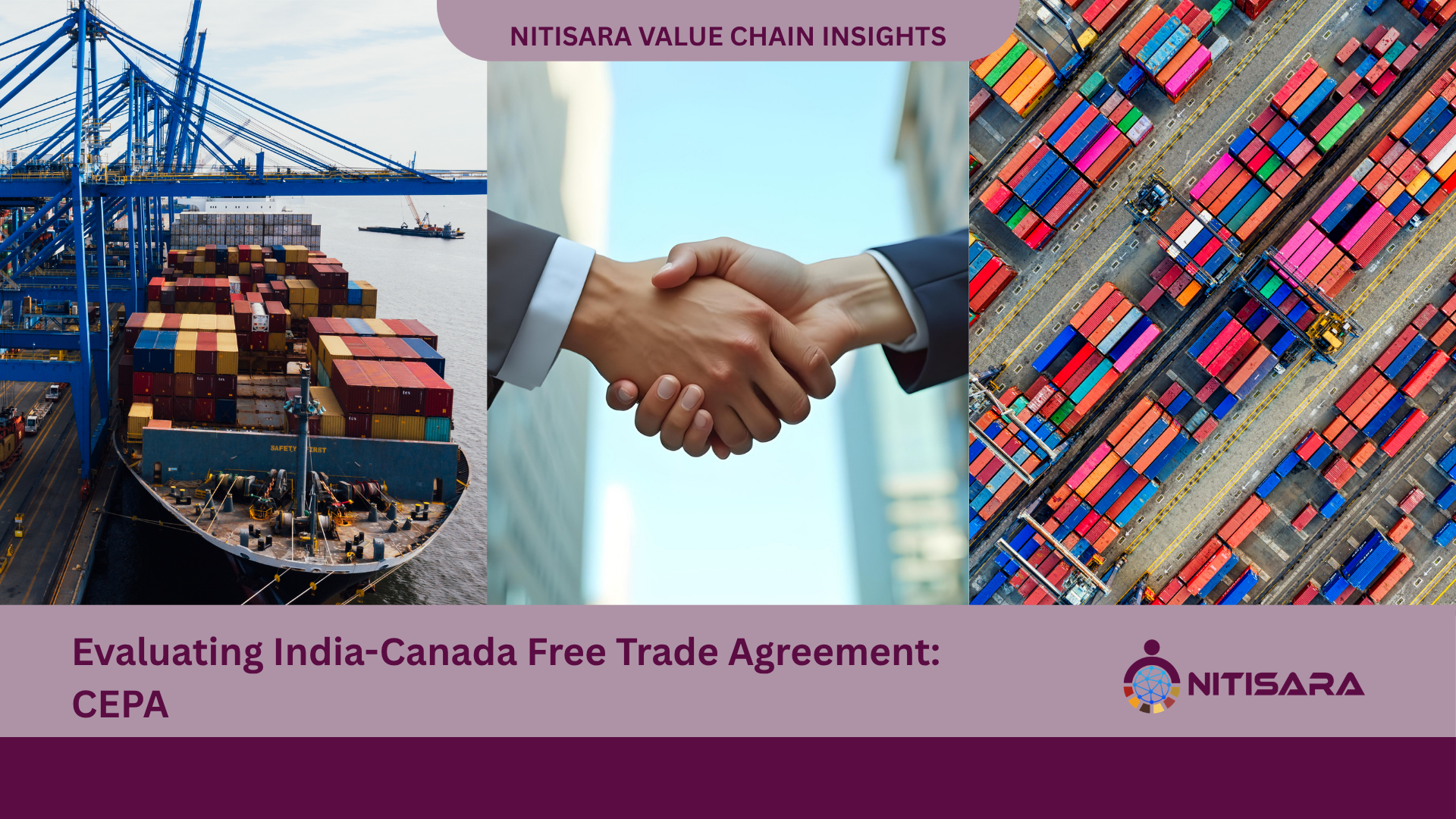
This article studies the India-Canada CEPA through four linked questions: whether the two sides can turn political normalization into commercial predictability, whether critical minerals can become a real supply-chain bridge, whether services and mobility can be disciplined without turning into a migration argument, and whether agriculture, standards, and data rules can be negotiated without losing domestic political support. The central argument is that CEPA is strategically attractive because the two economies are complementary, but it will only work if negotiators convert complementarity into executable rules on tariffs, investment protection, professional mobility, digital trade, customs facilitation, and standards recognition.
Introduction
The India-Canada Comprehensive Economic Partnership Agreement is not only a tariff negotiation. It is a reset mechanism for a relationship where commercial logic, diaspora ties, education flows, critical minerals, agriculture, digital services, and political risk all sit on top of one another. Canada has recorded two-way merchandise trade with India at about CAD 10.9 billion in 2025, with Canadian exports to India at about CAD 3.9 billion and imports from India at about CAD 7.0 billion. The services channel is even more revealing: Canada reported services exports to India of CAD 15.6 billion in 2024, driven heavily by education-related travel, while services imports from India were about CAD 3.8 billion. A serious CEPA therefore has to be judged by whether it improves the quality of flows, not merely by whether it adds another signed document to India’s FTA list.
CEPA Is A Reset Instrument, Not A Routine FTA
India and Canada already trade, invest, educate, and migrate through deep people-to-people channels, but the absence of a modern trade architecture keeps the relationship below its potential. Canada has more than 1.8 million people of Indian origin according to its 2021 census and counted 392,810 Indian study permit holders in 2024. These numbers create a commercial base that is unusual for a bilateral trade negotiation: students become consumers, alumni become business connectors, families support travel and remittances, and professional networks reduce trust barriers for firms entering unfamiliar markets. CEPA can formalize this base by reducing border frictions, clarifying rules for services, and creating confidence for pension funds, clean-technology firms, agrifood exporters, engineering companies, and Indian mid-sized manufacturers that want a North American channel beyond the United States.
Commercial layer Current numeric anchor Why it matters for CEPA Merchandise trade about CAD 10.9 billion in 2025 The goods base is meaningful but still small relative to the size of both economies. Canadian exports to India about CAD 3.9 billion in 2025 Energy, minerals, agrifood, forestry, and industrial inputs shape Canada’s offer. Canadian imports from India about CAD 7.0 billion in 2025 Indian consumer goods, machinery, chemicals, and electronics already have traction. Canada services exports to India about CAD 15.6 billion in 2024 Education and travel make services central, not secondary. India-origin population in Canada more than 1.8 million in 2021 Diaspora density lowers soft barriers for trade and investment. Source: Government of Canada, Canada-India relations page, date modified June 10, 2026; values rounded for readability.
Critical Minerals Give The Deal A Strategic Spine
The strongest supply-chain logic for CEPA sits in critical minerals. India is trying to scale batteries, electric mobility, grid storage, electronics, renewables, and advanced manufacturing while reducing overdependence on concentrated mineral-processing routes. Canada is a resource-rich economy with mining expertise, environmental permitting capacity, geological data, and a policy interest in export diversification beyond the United States. The fit is clear, but the execution is hard. A CEPA chapter that simply says ‘critical minerals cooperation’ would be too thin. The real questions are project financing, offtake agreements, processing location, ESG standards, transport reliability, investment screening, and whether Indian firms can participate upstream rather than merely buying minerals at the end of the chain. If CEPA can create predictable pathways for Indian capital, Canadian mining projects, and downstream manufacturing, it becomes an industrial policy bridge rather than a diplomatic slogan.
Services, Mobility And Data Are The Real Deal
The India-Canada negotiation is unusual because services may be more politically and economically important than goods. Education, IT services, engineering, finance, consulting, research collaboration, health technology, artificial intelligence, and professional mobility are the areas where the relationship already has depth. Canada’s own trade note highlights CEPA coverage across goods and services trade, investment, agriculture and agri-food, digital trade, mobility, and sustainable development. That scope matters because a modern trade agreement cannot treat digital delivery, temporary movement of professionals, and recognition of qualifications as side issues. Indian exporters of software, design, engineering, and business services need predictable entry rules, while Canada needs confidence that mobility provisions will not be confused with open-ended migration commitments. The most useful CEPA design would separate temporary business mobility from immigration politics, support credential pathways where sectors have shortages, and set data rules that allow digital services while protecting privacy and national security.
Agriculture And Standards Are The Difficult Half
The difficult negotiation will sit in agriculture, sanitary and phytosanitary standards, dairy sensitivities, pulses, food inspection, and rules of origin. Canada is a major agrifood exporter, while India protects small farmers and remains cautious about import surges in politically sensitive commodities. A shallow tariff bargain could create more controversy than trade. A better design would use phased concessions, quota discipline, safeguard clauses, transparent inspection standards, and cooperation on food processing, cold chains, and traceability. The same logic applies to industrial standards. Indian manufacturers want access, but market access becomes real only when testing, certification, lab recognition, and customs processes do not quietly erase the tariff benefit. The lesson from other FTAs is simple: tariff preference opens the gate, but standards decide who can actually walk through it.
From Trade Target To Execution
Canada has stated an ambition to more than double two-way trade with India to CAD 70 billion annually by 2030, while Indian public statements have also framed a large expansion target around the USD 50 billion level. Either way, the arithmetic requires a step-change, not incremental customs reform. Moving from about CAD 10.9 billion in merchandise trade toward tens of billions in combined flows requires large projects, not only more containers. The practical agenda is therefore sectoral: minerals and clean technology, education and research, digital services, agrifood processing, infrastructure finance, life sciences, aerospace, and advanced manufacturing. Each sector needs a different instrument. Minerals need investment and offtake; services need mobility and data rules; agrifood needs standards; manufacturing needs rules of origin and supplier development; infrastructure needs pension-capital participation and policy stability.
Conclusion
The India-Canada CEPA has the potential to become one of India’s more strategically useful trade agreements because it connects market access with resources, skills, services, diaspora capital, and clean-technology supply chains. But the agreement will not succeed merely by reducing tariffs. Its value will depend on whether it can turn political recovery into commercial reliability, convert critical minerals into downstream industrial capacity, and build services rules that support mobility without triggering regulatory backlash. If CEPA is designed as a narrow goods agreement, it will underperform. If it is designed as a supply-chain, services, and investment architecture, it can become a durable corridor between India’s growth market and Canada’s resource-and-knowledge base. The views expressed do not represent the company’s position on the matter. This article does not represent AI-generated content. Stay informed through the Nitisara Platform and Blogs, and adapt to emerging trends that are poised to thrive in the competitive global marketplace.- https://nitisara.org/category/blogs-updates/.
References
1. Government of Canada, Canada-India relations. https://www.international.gc.ca/country-pays/india-inde/relations.aspx?lang=eng
2. Economic Times, Piyush Goyal says India, Canada aim to seal CEPA by year-end; target $50 billion trade by 2030. https://m.economictimes.com/news/economy/foreign-trade/india-canada-cepa-negotiations-aim-to-be-sealed-by-year-end-piyush-goyal-says-target-50-billion-trade-by-2030/articleshow/131320355.cms
3. Government of Canada, Canada critical minerals strategy. https://www.canada.ca/en/campaign/critical-minerals-in-canada.html