What is a Bill of Lading?
By admin
/ March 19, 2024
In the dynamic realm of international trade, the ‘bill of lading’ holds a pivotal role in ensuring the smooth transportation…
Read More



By Tejas Siddalingeshwar, Researcher, NITISARA
This article examines how sovereign wealth funds, public wealth funds, development banks, and state-backed infrastructure vehicles support trade infrastructure. It argues that sovereign investment is most effective when it crowds in private capital, improves project preparation, and links infrastructure to measurable trade-cost reduction. The danger is that patient capital can become politically directed capital if governance is weak
Introduction
Trade infrastructure is expensive, slow to build, and strategically important. Deep-water ports, freight corridors, logistics parks, inland terminals, power links, and digital customs systems require patient capital that does not demand immediate exit. Sovereign investors can play a distinctive role in this space because they combine long investment horizons with national development or strategic mandates.
Trade Infrastructure Needs Patient Balance Sheets
A port cannot be judged like a software product. Freight corridors, terminals, and logistics parks require land acquisition, permits, environmental clearances, engineering design, construction risk, demand uncertainty, and long payback periods. Private capital may participate, but it often demands de-risked projects, stable regulation, and clear revenue models.
Sovereign capital can fill the gap between national need and private risk appetite. It can provide early equity, anchor debt, guarantees, or project-preparation support. The objective is not to replace private capital; it is to make strategic infrastructure investable.
Investor type Typical contribution Trade-infrastructure value Sovereign wealth fund Long-horizon equity or co-investment. Anchors large projects and signals confidence. Development bank Debt, guarantees, technical assistance. Improves bankability and safeguards. Public wealth fund Domestic investment mandate. Links national savings to industrial capacity. Private infrastructure fund Equity and operational discipline. Brings project execution and asset management. Government budget Viability-gap funding or public works. Supports non-commercial but socially necessary assets. Source: Self-sourced synthesis based on World Bank PPI, Global Infrastructure Facility, Global Infrastructure Hub, and SWF Institute materials.
Ports and Corridors Create Network Effects
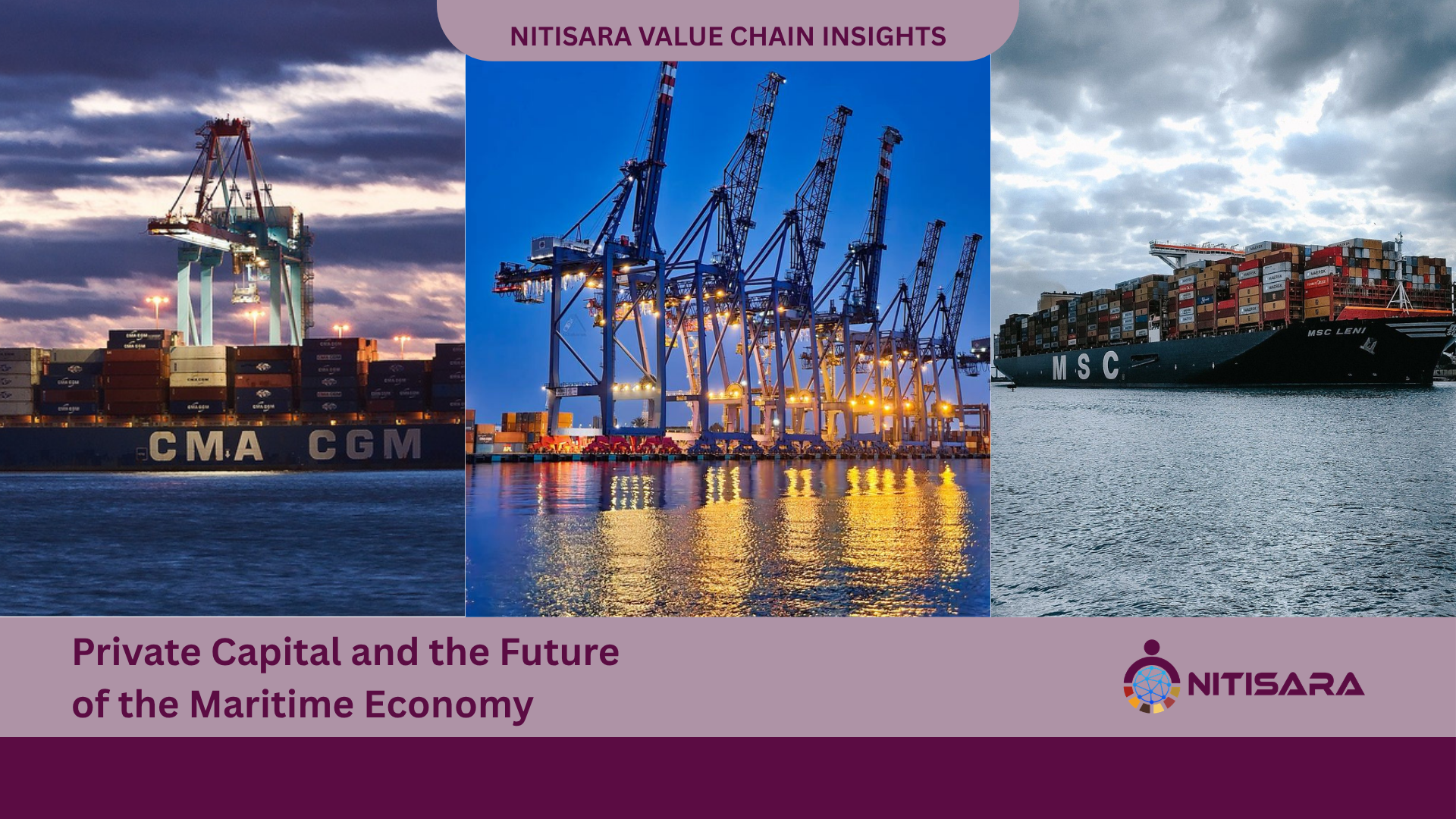
The value of a port is not the port alone. It depends on rail links, customs clearance, warehousing, trucking reliability, cold chains, inland waterways, power supply, and digital documentation. A deep-water port without inland connectivity becomes a stranded asset. A freight corridor without terminal efficiency can shift congestion from roads to yards. Sovereign investment is useful because it can coordinate these complementary assets. A private investor may finance a terminal; a sovereign-backed platform can support the corridor, logistics park, or energy system around it. This coordination is central to trade competitiveness.
Crowding In Private Capital
The most valuable sovereign investment does not crowd out private capital. It crowds it in. This can happen through first-loss protection, anchor equity, currency-risk mitigation, construction-stage guarantees, or project-preparation grants. The public balance sheet absorbs risks that private capital is poorly placed to price, while private capital brings efficiency and discipline.
Project phase Main risk Useful sovereign role Preparation Poor feasibility, unclear demand, weak permits. Fund feasibility studies and transaction advisory. Construction Cost overrun, land delay, contractor risk. Provide guarantees or milestone-based public support. Ramp-up Demand uncertainty in early years. Use minimum revenue support or blended finance. Operation Regulatory or tariff instability. Support transparent concession design. Expansion Coordination with adjacent assets. Use platform investment across corridors and logistics nodes. Source: Self-sourced capital-stack framework based on World Bank and Global Infrastructure Facility project-preparation guidance.
The Logistics Competitiveness Channel
Trade infrastructure affects competitiveness by reducing time, uncertainty, spoilage, and inventory buffers. A manufacturer that can ship reliably can operate with lower working capital. A farm exporter with cold-chain access can sell into higher-value markets. A port with predictable turnaround supports shipping-line confidence. These gains do not always show up as direct project revenue, which is why public or sovereign capital may be justified. The economic return therefore extends beyond tolls, leases, or port fees. It appears in export reliability, lower logistics cost, regional industrialization, reduced dwell time, and greater participation of smaller firms in trade.
Governance Is the Deciding Variable
Sovereign capital can also misallocate resources. A fund with unclear mandates may finance prestige projects, politically favored contractors, or assets with weak commercial logic. Infrastructure is vulnerable to optimism bias because traffic forecasts, land values, and future industrial demand are easy to overstate. Good governance requires independent appraisal, published project criteria, procurement transparency, environmental and social safeguards, conflict-of-interest controls, and post-completion performance review. The question is not whether the investor is sovereign or private. The question is whether the capital is accountable.
India and the Corridor Logic
India’s trade-infrastructure challenge is not only port capacity. It is the full corridor from factory gate to foreign buyer. Logistics parks, rail freight, container availability, customs digitization, testing infrastructure, and warehousing determine whether export growth is cost competitive. Sovereign and state-backed capital can support this corridor logic if projects are selected by trade impact rather than political visibility. The correct performance question is concrete: Did the project reduce cost per container, lower dwell time, improve reliability, expand export capacity, or connect industrial clusters to markets? If the answer is yes, sovereign capital has served trade infrastructure. If the answer is only that money was deployed, the investment has not yet proven its economic value.
What the State Should Own, and What It Should Not
The case for sovereign investment is strongest where assets have public-good characteristics, long payback periods, or coordination failures. It is weaker where a project is commercially clear and private capital is already willing to fund it without state support. The discipline is knowing where the public balance sheet adds value. For trade infrastructure, the state or a sovereign-backed platform may need to support land assembly, trunk connectivity, digital customs systems, rail links, or early-stage preparation. But once an asset has predictable cash flows, private operators and infrastructure funds can often manage it efficiently. Sovereign investment should prepare and de-risk, not permanently politicize every asset.
Project Preparation Is Invisible Infrastructure
Many infrastructure gaps are not funding gaps at first; they are preparation gaps. Poor feasibility studies, weak demand forecasts, unclear permits, and badly structured concessions keep private capital away. Project preparation looks less glamorous than a ribbon-cutting ceremony, but it can decide whether a logistics corridor attracts long-term investment.
KPI What it measures Why sovereign investors should care Port dwell time Time cargo spends before clearance or onward movement. Directly affects exporter reliability and inventory cost. Cost per container Door-to-port or port-to-door logistics burden. Shows whether infrastructure lowers trade friction. Private capital mobilized Ratio of private investment to sovereign/public support. Tests crowd-in effect rather than public spending alone. Modal shift Share moving from road to rail/water where efficient. Signals productivity and emissions benefits. Cluster connectivity Industrial areas linked to ports and corridors. Connects infrastructure to export production. Source: Self-sourced KPI set based on World Bank PPI, Global Infrastructure Facility, and logistics competitiveness frameworks.
Strategic Infrastructure Is Also a Trade Signal
Infrastructure investment signals national seriousness to manufacturers and logistics providers. A firm deciding whether to build export capacity studies not only wages and taxes, but also port access, customs predictability, power reliability, and multimodal connectivity. Sovereign-backed infrastructure can therefore influence private industrial location decisions. This is why infrastructure should be aligned with export clusters. A logistics park far from industrial demand may become real estate. A corridor linked to chemicals, automobiles, electronics, agriculture, or textiles can become a trade platform. Sovereign capital should follow trade logic, not only geographic symbolism.
Revenue Discipline and Public Value
Trade infrastructure projects need two forms of discipline. The first is commercial discipline: traffic forecasts, user charges, concession terms, and operating costs must be realistic. The second is public-value discipline: the project must improve trade productivity even when direct revenue does not capture every benefit. A rail freight link, for example, may reduce congestion, emissions, and inventory costs beyond what appears in project cash flow. Sovereign investors are well placed to hold both views at once. They can accept long payback periods when the economic case is strong, but they should not accept vague development language as a substitute for measurement. Every major project should have a baseline, a target, and a post-completion review. This is especially important for logistics parks. A park with warehouses but weak freight connectivity is a real estate project. A park with customs integration, cold-chain capacity, multimodal access, and nearby exporters is trade infrastructure. The difference is not cosmetic; it changes the economic return.
Public value should also include resilience. Redundant port capacity, alternative freight routes, and diversified logistics nodes may look inefficient in normal times but valuable during shocks. Sovereign capital can justify such resilience investments when the national trade system depends on continuity.
Conclusion
Sovereign investment can unlock trade infrastructure where private capital alone is too cautious and public budgets alone are too limited. Its strength lies in patience, coordination, and risk absorption. Its weakness lies in governance risk. The strongest model uses sovereign capital to prepare projects, crowd in private investors, and measure performance through logistics and export outcomes. Trade infrastructure should be judged by what it enables, not by how large the announcement sounds.
—–
The views expressed do not represent the company’s position on the matter. This article does not represent AI-generated content. Stay informed through the Nitisara Platform and Blogs, and adapt to emerging trends that are poised to thrive in the competitive global marketplace.- https://nitisara.org/category/blogs-updates/.
References
1. World Bank, Private Participation in Infrastructure Database. https://ppi.worldbank.org/
2. Global Infrastructure Facility, World Bank Group. https://www.globalinfrafacility.org/
3. Global Infrastructure Hub, Global Infrastructure Outlook. https://outlook.gihub.org/
4. SWF Institute, Sovereign Wealth Fund Rankings. https://www.swfinstitute.org/fund-rankings/sovereign-wealth-fund
5. UNCTAD, World Investment Report 2024. https://unctad.org/publication/world-investment-report-2024