What is a Bill of Lading?
By admin
/ March 19, 2024
In the dynamic realm of international trade, the ‘bill of lading’ holds a pivotal role in ensuring the smooth transportation…
Read More


By Sagar kumar, Researcher, Nitisara
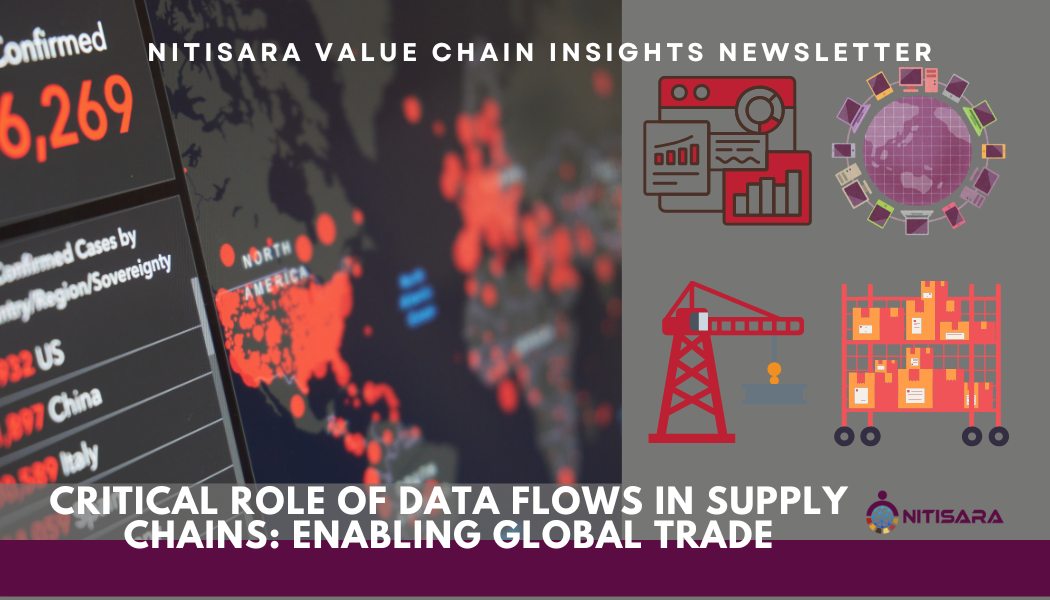
In the age of digital globalization, data has emerged not just as a supporting component of global trade but as an essential lifeline for the smooth functioning of modern supply chains. The International Chamber of Commerce (ICC), in its June 2025 policy brief, emphasizes that cross-border data flows are as critical to trade as the movement of physical goods. However, regulatory fragmentation, data localization laws, and weak international cooperation threaten to choke this lifeline, resulting in disrupted logistics, higher costs, and limited participation by small businesses. This article distills the findings and explains the stakes, challenges, and necessary policy actions to preserve the free, secure, and efficient flow of data across borders.
Data has become the new infrastructure of global trade, underpinning the seamless movement of goods, capital, and services across borders. According to the World Bank (2024), over $2.5 trillion worth of global trade flows are now digitally enabled, with supply chain data exchanges—such as e-manifests, trade finance documentation, and logistics tracking—reducing transaction costs by up to 15–25%. The OECD estimates that digitally optimized supply chains can improve trade efficiency equivalent to removing physical tariffs of 5–10%, highlighting the growing strategic value of data as a trade facilitator. From customs pre-clearance to real-time cargo visibility, data interoperability and digital trust are becoming as vital as physical ports and warehouses in sustaining cross-border commerce.
However, this dependence on digital supply chains introduces new complexities in governance, security, and resilience. Around 70% of global manufacturers now rely on cloud-based supply chain platforms, and cross-border data flows have grown 45-fold since 2010 (McKinsey, 2024). Yet, inconsistent data standards and fragmented digital infrastructure often cause bottlenecks—especially in developing economies. For instance, the UNCTAD Trade Digitalization Index shows that fewer than 30% of countries have fully integrated electronic single-window systems for trade. This data asymmetry not only slows shipments but also hampers visibility in risk management and ESG compliance. Strengthening trusted, interoperable, and transparent data flows is therefore critical—not just for trade competitiveness but also for ensuring supply chain resilience in a world shaped by digital interdependence.
The effectiveness of global trade networks today depends not only on the physical movement of goods but on how seamlessly data can move across digital systems. Interoperability—the ability of different platforms, ports, and logistics systems to communicate—is foundational for trusted data flows. According to the World Economic Forum (2024), lack of interoperability adds up to $350 billion annually in trade inefficiencies. Many exporters still face challenges where customs systems, port terminals, and banking platforms operate on siloed databases. Emerging frameworks like the WCO Data Model, UN/CEFACT standards, and API-based integration under the WTO Trade Facilitation Agreement (TFA) are helping unify documentation and data exchange across supply chains. For example, India’s National Logistics Portal (Marine) now uses a single-window electronic system linking customs, ports, and shipping agents—reducing clearance time by nearly 40% since 2021.
Beyond interoperability, data standardization and traceability technologies—including blockchain, IoT, and AI-driven digital twins—are reshaping how supply chains ensure authenticity and compliance. Blockchain-based trade documentation can cut processing time from 7 days to less than 24 hours, while AI-enabled traceability improves risk detection and demand forecasting accuracy by up to 30% (Deloitte, 2023). For instance, IBM and Maersk’s TradeLens demonstrated how digital ledger systems can reduce paperwork-related costs by 15–20% before its operational sunset, setting the stage for industry-wide learnings on digital trust. Similarly, EU’s Data Act and India’s Digital Public Infrastructure (DPI) framework emphasize secure, standardized data sharing for cross-border logistics, digital payments, and trade finance. Together, these enablers lay the foundation for a transparent, resilient, and digitally sovereign trade ecosystem—one where trusted data exchange is as critical as trusted goods movement.
Why Data Flows Matter in Supply Chains?
Supply chains today are increasingly powered by digital technologies such as cloud computing, the Internet of Things (IoT), AI-driven analytics, and blockchain. All of these rely on seamless, real-time data flows across multiple jurisdictions. According to the OECD, even a 0.1-point reduction in digital restrictions can boost exports by 145%. Conversely, complete data autarky could reduce global GDP by 4.5% and exports by 8.5%. Data enables coordination across diverse stakeholders—farmers, suppliers, manufacturers, distributors, and retailers—while enabling traceability, compliance, forecasting, and customer engagement.
| Supply Chain Stage | Countries Involved | Key Data Transferred |
| Sourcing | Country A | Supplier info, purchase orders |
| Manufacturing | Country B | Inventory levels, quality control |
| Distribution | Country C | Shipment tracking, customs documents |
| Retail | Country D | Sales data, customer feedback |
This interconnected system depends on continuous, trusted, and secure data exchanges, without which operations break down.
While digital connectivity has unlocked unprecedented visibility and efficiency in global trade, it has also exposed critical governance and cybersecurity gaps. As supply chains digitize, the volume of cross-border data transfers has surged by over 4,500% since 2010 (McKinsey, 2024), but regulatory frameworks have not kept pace. Fragmented data protection laws—such as the EU’s GDPR, India’s Digital Personal Data Protection Act (DPDPA), and varying localization rules across Asia and Africa—create complex compliance barriers for global manufacturers and logistics providers. A 2023 OECD survey found that over 60% of exporters cite regulatory divergence in data handling as a top barrier to adopting digital trade systems. This fragmentation raises transaction costs, slows digital documentation exchange, and limits participation of MSMEs in global supply chains.
Cybersecurity remains another critical vulnerability. The World Trade Organization (WTO) reported that nearly 45% of logistics firms experienced a cyber incident in 2023, with average losses exceeding $3.6 million per breach. Maritime and air cargo operators, in particular, face threats from ransomware attacks that disrupt customs data, vessel tracking, and cargo manifests. Additionally, data sovereignty concerns—where countries seek to retain control over locally generated trade data—can limit interoperability between global platforms. For example, differing policies on AI-driven risk profiling and e-certification between the EU and developing countries often delay digital clearance processes. To bridge these governance gaps, international alignment through mechanisms like the Digital Economy Partnership Agreement (DEPA) and G7 Data Free Flow with Trust (DFFT) initiative is essential. These frameworks aim to harmonize cross-border data standards while ensuring security, privacy, and transparency. For India, aligning its logistics digitalization agenda with these global norms can strengthen participation in global value chains, enhance trade predictability, and reinforce supply chain resilience in the face of digital disruption.
Barriers to Cross-Border Data Flows
Despite their importance, data flows face growing constraints stemming from inconsistent national policies. The ICC outlines several key regulatory challenges.
| Barrier | Description | Supply Chain Impact |
| Regulatory Fragmentation | Divergent national rules on data transfers | Legal uncertainty, higher compliance costs |
| Data Localisation | Mandates to store/process data domestically | Reduced supply chain visibility, delays |
| Restrictive Policies | Conflicting rules for personal/non-personal data | Higher costs, less automation |
| Lack of Standards | Incompatible formats and rules | Manual processing, redundant systems |
| Forced Disclosure | Weak protections or mandatory sharing | Risk of competitive exposure |
| Traceability Barriers | Restrictions on end-to-end data visibility | Difficulty complying with traceability laws |
For example, a shipping document might contain both logistical and personal data (e.g., driver information), but regulations treating all such data under strict privacy mandates force companies to create localized, fragmented systems. This affects operational continuity, especially in time-sensitive logistics.
Data Types in the Trade Lifecycle
The ICC categorizes cross-border data into personal and non-personal types, flowing across every stage of the trade lifecycle. Critically, personal data is often inseparable from operational datasets. For instance, a predictive logistics algorithm analyzing warehouse performance might require anonymized employee or customer behavior data.
| Stage | Type of Data | Classification |
| Sourcing | Supplier info, compliance certificates | Non-personal |
| Manufacturing | Inventory levels, IoT sensor data | Non-personal |
| Distribution | Shipping manifests, tracking | Non-personal |
| Consumer Interface | Sales, customer feedback | Mixed (mostly personal) |
| Post-Sale | Return records, recycling data | Non-personal |
| HR/Operations | Employee, payroll data | Personal |
Impacts on Supply Chain Traceability and Compliance
Modern regulations like the EU Deforestation Regulation and the US Uyghur Forced Labor Prevention Act demand granular visibility into the origin of materials and ethical sourcing. Achieving compliance hinges on the ability to move data across tiers and jurisdictions.Without interoperable frameworks, gathering, verifying, and sharing compliance documents across suppliers becomes burdensome, risking non-compliance and lost market access. Many categories of commercial data—supplier lists, contract terms, profit margins—constitute CBI. Inconsistent protection laws across countries pose risks of forced disclosure or unauthorised access. This creates a chilling effect: companies may refrain from data-sharing or limit cross-border collaborations due to fear of losing competitive advantage. To counter the fragmentation, the ICC recommends coordinated global policy action.
| Recommendation | Key Action |
| 1. WTO Multilateral Rules | Advance global frameworks via the WTO’s E-Commerce Joint Statement Initiative |
| 2. Risk-Based Regulation | Differentiate between personal and non-personal data |
| 3. Interoperable Frameworks | Avoid blanket data localisation and promote mutual recognition of standards |
| 4. Protect CBI | Enforceable protections for confidential commercial information |
| 5. Digital Trade Environment | Support harmonised digital documentation and trusted trader frameworks |
These recommendations aim to reduce friction, enhance trust, and promote inclusive access to digital trade, particularly for MSMEs.
Why Does This Matters for MSMEs and Global Development? Data as the Fourth Flow
MSMEs represent 90% of businesses worldwide and are crucial for job creation and innovation. However, they lack the compliance resources that large multinationals possess. Without reforms, data-related trade barriers will continue to marginalize them. Further, in a world increasingly shaped by geopolitical fragmentation, building resilient and inclusive supply chains is a global imperative. Trustworthy, secure, and frictionless data flows are foundational to that goal. Alongside goods, services, and capital, data must be recognized as the fourth flow critical to global trade. Fragmented, inconsistent, and overly restrictive data policies act as non-tariff barriers that stifle innovation, limit resilience, and isolate smaller players from global markets. The ICC’s message is clear: cross-border data flows should be protected and promoted with the same urgency and coordination as physical trade. A future-ready policy environment will enable not only resilient supply chains but also inclusive, secure, and sustainable global commerce.
The evolution of trusted digital infrastructure in global trade is exemplified by Singapore’s TradeTrust and India’s Unified Logistics Interface Platform (ULIP)—two leading initiatives demonstrating how interoperable, transparent data ecosystems can transform cross-border logistics and supply chain governance. Together, TradeTrust and ULIP represent complementary approaches to building data-resilient trade corridors. While Singapore focuses on cross-border legal recognition and digital trust, India emphasizes infrastructure-scale data integration and interoperability. Their convergence points toward a future model of global trade digitalization, where trusted data flows, real-time visibility, and standardized digital documentation enable seamless, low-carbon, and resilient supply chains—foundational to the next era of global commerce.
Singapore’s TradeTrust, launched by the Infocomm Media Development Authority (IMDA), enables the legal recognition of electronic trade documents such as bills of lading, invoices, and certificates of origin. Built on blockchain technology, it ensures tamper-proof document exchange and authenticity verification across jurisdictions. TradeTrust aligns with international standards like UNCITRAL’s Model Law on Electronic Transferable Records (MLETR), allowing seamless data sharing among ports, shippers, and customs authorities. Since 2022, over 200 global shipping and trade entities have adopted TradeTrust, leading to processing time reductions of up to 70% and savings of approximately USD 4 billion annually in global documentation handling costs (IMDA, 2024).
In India, the Unified Logistics Interface Platform (ULIP)—developed by the Ministry of Commerce and Industry under the National Logistics Policy (NLP)—is revolutionizing domestic trade data integration. ULIP connects 30+ digital systems from ports, customs, railways, and road transport through secure APIs, enabling real-time visibility across multimodal logistics networks. The platform also supports data exchange between logistics operators, fintech players, and trade compliance systems, enhancing predictability and transparency. As of mid-2024, ULIP has onboarded over 900 enterprises, facilitating data-driven decision-making for more than 10 million shipments monthly, and cutting administrative delays by 25–30%.
As global trade transitions into a data-driven paradigm, the ability to exchange trusted, interoperable, and real-time information has become as essential as the movement of goods themselves. The World Economic Forum (2024) projects that by 2030, over 80% of cross-border trade documentation will be digitized, potentially generating USD 6 trillion in efficiency gains and reducing transaction time by up to 50%. Building the digital backbone of trade thus requires coordinated investment in digital public infrastructure, regulatory harmonisation, and data governance frameworks that foster both trust and inclusivity. For emerging economies like India, integrating platforms such as ULIP, ICEGATE, and ONDC for logistics and trade can position the country as a global digital trade hub. Scaling these systems with AI-enabled analytics, blockchain traceability, and digital ID frameworks will further enhance transparency, fraud prevention, and sustainability reporting—key criteria in global ESG-aligned trade. Meanwhile, international efforts like the Digital Economy Partnership Agreement (DEPA), WTO e-commerce negotiations, and G7’s Data Free Flow with Trust (DFFT) will shape the norms for secure, privacy-preserving, and interoperable trade data exchange.
However, the path forward also demands bridging digital capacity gaps—particularly for MSMEs that represent over 90% of global exporters but often lack access to interoperable platforms or data standards. Investment in digital literacy, open APIs, and SME data access frameworks will ensure inclusive participation in the digital trade revolution. As physical and digital infrastructures converge, the next decade will witness “smart trade corridors” where ports, customs, banks, and logistics providers operate on shared, standardized, and transparent data ecosystems. Ultimately, the future of global trade will be written in data—and its success will depend on how well nations can collaborate to ensure that these flows are secure, equitable, and sustainable. By embedding digital trust, interoperability, and circular transparency at the heart of trade infrastructure, the world can unlock a more resilient, efficient, and inclusive trading system, capable of supporting both economic growth and planetary well-being.
The views expressed do not represent the company’s position on the matter. Stay informed through Nitisara Platform and Blogs and adapt to emerging trends are poised to thrive in the competitive global marketplace. – https://nitisara.org/category/blogs-updates/