What is a Bill of Lading?
By admin
/ March 19, 2024
In the dynamic realm of international trade, the ‘bill of lading’ holds a pivotal role in ensuring the smooth transportation…
Read More


By Shakthi M, Researcher at NITISARA
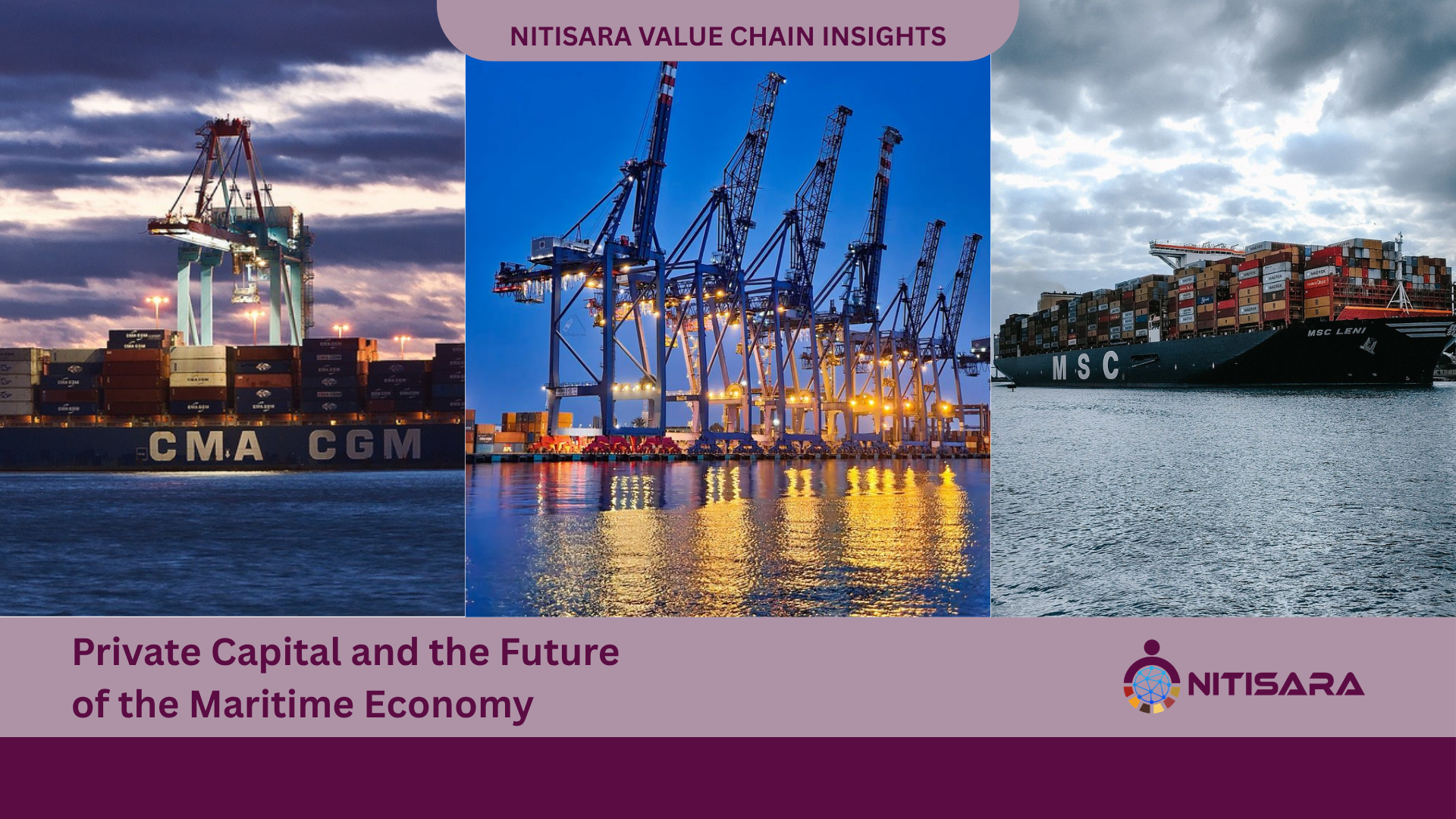
For most of its history: German KG funds, Norwegian banks with dedicated ship-lending desks, Greek family capital, and export credit agencies out of Japan, South Korea, and China. Then 2008 happened. The world’s fleet wasn’t just in need of upgrading, it was in urgent need of a new wave of financing, and thats when private equity firms, alternative credit funds, and infrastructure managers – bringing with them the same strategies they’d used for roads, airports, and power plants.Private capital shifted from saving the sector to controlling it. The private money has not only infiltrated the financing of ships but has also penetrated ports, logistics, decarbonisation and the wider Blue Economy, changing the maritime economy from what it was 15 years ago. The old question of who controls maritime trade is now a question of who funds maritime trade.
During the financial crisis in 2008, banks with particular shipping departments were forced to withdraw and the world was more than ever in need of modernization of its fleet. Private equity companies, alternative credit funds, leasing companies, and infrastructure managers filled the void at that time, applying the same underwriting principles used in treating any hard infrastructure investment with vessels, ports and terminal concessions.The global shipping finance market rose to $89.4 billion back in 2025 and is expected to hit $114.8 billion by 2034, and private equity and institutional investors now make up about 11.4% of demand for shipping financing from end-users. Private equity’s march continues, and is running in reverse, too—from new shipbuilding into ship maintenance, repair and overhaul, where margins are higher. Together they create a maritime economy that is different than the one that was in place 15 years ago. For shipowners who cannot secure commercial bank financing, shadow financing is no longer an occasional remedy; the era of who controls maritime trade and in what manner is coming to be the era of who controls the financing for maritime trade.
The investment landscape breaks into three genuinely distinct layers — physical infrastructure, the logistics and digital stack, and strategic chokepoints — each attracting a different type and scale of capital. When it comes to the infrastructure layer, the battle for terminal ownership is at an unprecedented level: DP world announced that it would invest $2.5 billion over 2025, to strengthen and expand its global logistics network, and Hapag-Lloyd plans to increase the number of its ports to over 30 by 2030, including the Aracruz terminal project in Brazil. Port authorities and tenants in the United States were planning $163 billion in capital expenditures through 2025 and the pipeline continues to expand – including Long Beach’s $1.567 billion Pier B On-Dock Rail Support Facility, which is the biggest single port rail investment in U.S. history. On the logistics side, access to the hinterland is more promising for the ports which are integrating land-rail-inland-water modes of transport, while automation and digitisation are moving forward as ports invest in IoT, AI-based logistics and greened operations to reduce dwell time and enhance cargo flow. The role of the government capital at the strategic level is increasingly blending with the private capital. The basic concepts behind port reform are enshrined in the World Bank’s new Port Reform Toolkit 2025, which states that ports are too important to leave to the market, too complex to manage without private involvement. What emerges is a geography in which all major ports on all trade routes are trading ports, logistics hubs and strategic national interests, where private investors are at the centre of each.
International trade networks based on the exchange of goods and trade are becoming more efficient, resilient, and sustainable due to the increase in private investment across the global economy. This investment includes the integration and financing of digital and automated logistics, port and low-carbon shipping infrastructure and solutions. This trend also indicates the recognition of greater value in integrated maritime trade networks and the need for their assets and investment to be more connected and interdependent. This investment actively addresses the development of new trade routes, increased port capacity, and improved and integrated trade and transport systems. It also addresses the growing need for supply chain resilience to global geopolitical disruptions and changes in climate. In June 2026, Adani Ports and Special Economic Zone (APSEZ) announced an $850 million investment plan covering technology upgrades, decarbonisation, and capacity expansion – with up to $100 million earmarked for a partnership with US-based Kaleris to deploy AI-led terminal operating systems across 15 container terminals, expected to deliver up to 20% improvement in crane productivity and 14% improvement in truck productivity. Although there are difficulties posed by concerns over regulations, the impact and extent of capital investment, and geopolitical frictions, private investment is increasingly dominating the integration and modernization of the trade and shipping networks of the global economy.
Long-term investors want to include more types of assets in a portfolio. Some of those new assets include the infrastructure used in global trade. Investment in trade infrastructure is long-lasting and provides reliable returns. Projects such as ports and terminals as well as maritime industrial zones and offshore energy hubs attract the interest of institutional investors because, in addition to reliable returns, they have revenues that grow at least as fast as inflation and provide a strong competitive position with limited market participants. The port infrastructure market, valued at $213.38 billion in 2025, is projected to reach $316.51 billion by 2034 — a growth rate that consistently outpaces GDP in most developed markets. Abu Dhabi’s ADIA leads the Infrastructure Investor Global Investor 75 ranking with $47.6 billion in infrastructure commitments, while CPP Investments and La Caisse collectively manage over $81 billion in infrastructure exposure, with direct or co-investment positions in port and maritime transport assets. The changing global trading environment and the path toward shipping that has a lower carbon footprint has increased the investment prospects of trade infrastructure. Investment in trade-related infrastructure and logistics has been increased by equity capital, infrastructure funds, sovereign funds, and pension funds. Technological changes such as automation and digital changes have increased the productivity of trade infrastructure further enhancing the investment appeal. While there are a host of geopolitical and regulatory issues that affect the infrastructure and a large sunk cost of capital, the increasing focus on sustainability makes this type of investment more appealing.
The new wave of investments for the Blue Economy and maritime sectors is a sign of a new investment pattern in the world, and of a convergence of the sustainability, economic and technological dimensions. Maritime investment has shifted away from a focus on shipping and port infrastructure and offshore investments in hydrocarbons, and towards offshore renewables, aquaculture, marine biotech, smart ports, and ocean tech. Blue economy VC funding surged by 5x in 8 years and hit $3 billion in 2025, marking the fastest growing vertical in European climate tech, as the number of deals increased by 40% and the median size of those rounds tripled. Maritime tech firms have already brought in $1.96 billion in equity capital during the first three months of 2026, a 184% rise from the same period last year. The $100m Motion Ventures Fund II has a dedicated focus on at least 25 maritime digitalization and decarbonization startups, with corporate LPs across the shipping value chain driving adoption in ports and fleets. Private equity, VC and institutional investors view the maritime and Blue Economy as a space where long-term value and resilient cashflow can be realized and where impact on key ESG objectives is likely to be the most positive. While market structure, technology and funding are all obstacles, decarbonization and quickly changing technology are presenting new opportunities for additional investment. Despite the geopolitical volatility and the need for significant capital expenditure, the need to decarbonize, the advances of technology and the support of policy, all offer an incentive for investment. Private capital is in a unique position to help create a balance between achieving both economic as well as ecological goals.
The maritime economy that’s taking shape looks a bit different from the one we’re used to – ports, logistics networks, even decarbonization plans are increasingly backed by the same private capital that used to stay on the sidelines. The ships and the cargo haven’t really changed. What has changed is who’s funding it all, and over time, that tends to shape who has the biggest say when things get difficult.
The article has not used an AI tool to generate article-related content. The views expressed do not represent the company’s position on the matter. Stay informed through the Nitisara Platform and Blogs, and adapt to emerging trends that are poised to thrive in the competitive global marketplace. – https://nitisara.org/category/blogs-updates/
https://www.technavio.com/report/port-infrastructure-market-industry-analysis
https://www.fortunedatavista.com/industry-analysis/port-infrastructure-market
https://blogs.worldbank.org/en/transport/public-and-private-sector-in-port-reform-and-investments