What is a Bill of Lading?
By admin
/ March 19, 2024
In the dynamic realm of international trade, the ‘bill of lading’ holds a pivotal role in ensuring the smooth transportation…
Read More


By Adarsh Gaikwad, Researcher at NITISARA
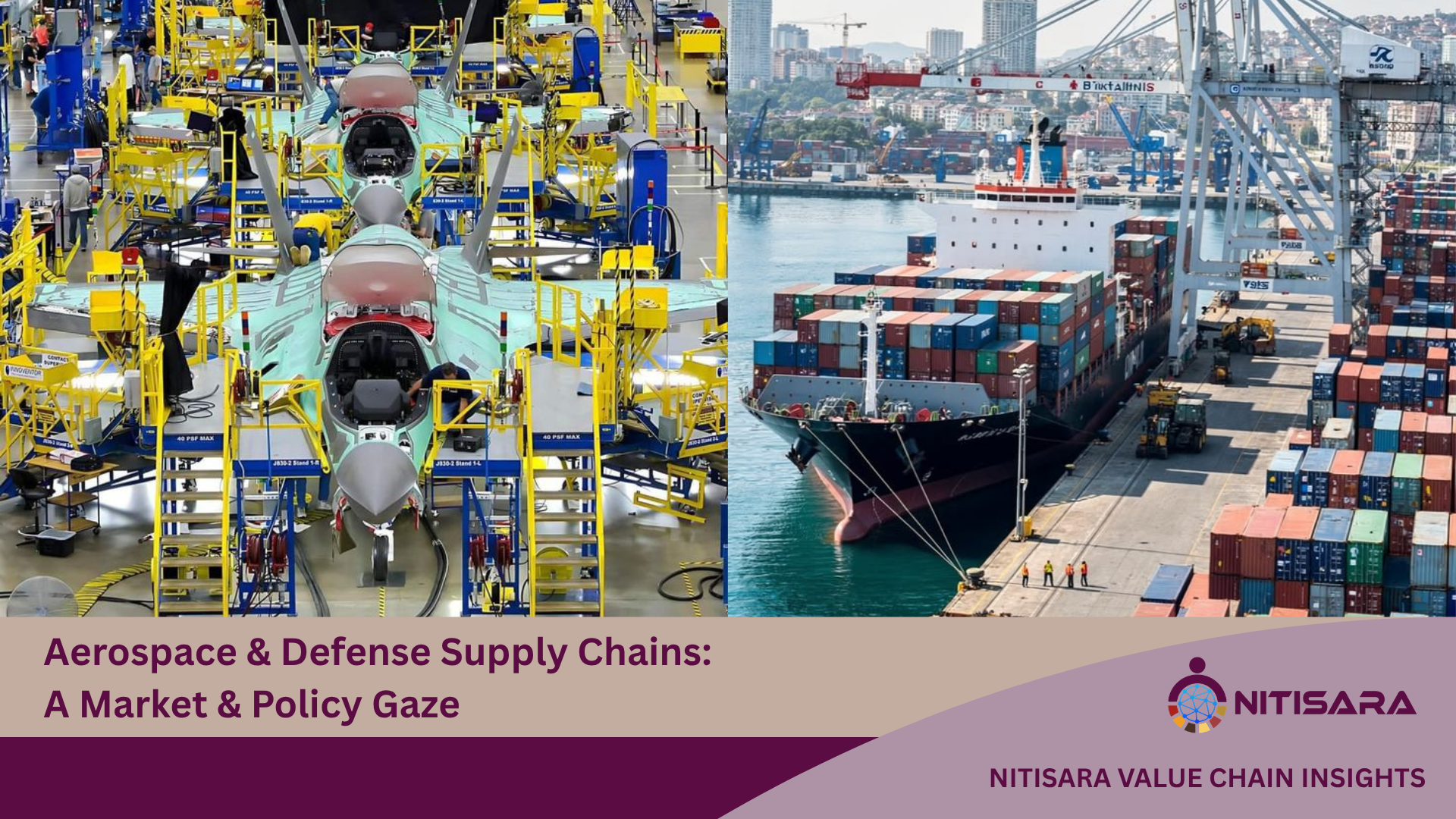
This article discusses new and upcoming trends in defense and aerospace supply chains and the risks they pose. It covers ideas about strategic autonomy, local manufacturing, and the economic reasons for creating resilient defense value chains. Also, it examines critical aspects of supply chain resilience and the policies shaping India’s defense industry. The research aims to address important questions in the sector: why nations cannot just buy cheaply made products from others, and what it takes to achieve independence in defense production.
In 2025, global defense spending reached record levels, with the U.S. alone spending $849.8 billion, about 40% of which went to developing supply chains and addressing bottlenecks. Europe added €800 billion for defense readiness. Still, despite rising budgets, the aerospace and defense industry faces a troubling reality. The supply chains essential for national security are weak, concentrated, and increasingly vulnerable to geopolitical risks.
Standard trade theory suggests that countries should focus on what they do best and import what others can produce more cheaply. But, defense production doesn’t follow this same logic. When a nation relies on a foreign supplier for jet engines, missile guidance systems, or semiconductors, it accepts not just a trade dependency but also a strategic risk. During a crisis, export controls tighten, licenses get revoked, and supply lines disappear. The cost of this dependency is often unseen during normal times, only showing up when it’s too late to act.
This risk is not theoretical. A modern combat aircraft has thousands of unique and different parts from hundreds of suppliers across various countries. In 2025, an industry official pointed out that a delay in a single microelectronic component can pause an entire assembly line. While the U.S. aerospace and defense sector contributed over $1 trillion to the economy in 2024, it still faced serious shortages in engine components, composite structures, and thermal systems for its advanced programs. Economic strength does not guarantee supply chain security.
For decades, aerospace manufacturers focused on cost and predictability. This strategy worked well in a stable global context, but it is much less effective now. PwC noted increasing concentration in critical defense inputs. In 2024, Chinese firms provided 9.3% of primary contractors in major U.S. defense programs across nine key sectors. Export controls on rare earths, restrictions on semiconductors and chips, and tightening allied procurement rules are changing the economics of global defense manufacturing.
Export controls are more than just trade barriers or some restrictions. They are tools for strategic policy. When a government limits the export of high-precision components or dual-use technologies, it is indicating which partnerships it trusts. A 2025 study by AIA and Kearney found that nearly 60% of aerospace and defense companies now see technology sovereignty as a top supply chain priority. Local manufacturing, or making crucial components domestically or through trusted allies, has shifted from a policy goal to an operational necessity.
India’s current policy landscape marks a significant shift in the history of the country’s defense industry. The Positive Indigenization Lists have banned imports of over 500 essential platforms and components, pushing manufacturing demands towards domestic producers. The iDEX framework has incorporated 619 startups and MSMEs into the defense innovation ecosystem, leading to 430 signed contracts by early 2025. The defense budget for 2025–26 is set at ₹6.81 lakh crore, more than two and a half times the amount allocated a decade ago.
| Initiative / Metric | Key Details & Strategic Impact |
| C-295 Aircraft Production | Manufactured at the Tata Aircraft Complex (Vadodara, opened October 2024). 40 out of 56 units are being built entirely in India. |
| Global Aerospace Sourcing | Rolls-Royce plans to significantly scale up its sourcing of aerospace components from Indian suppliers over the next 5 years. |
| Defense Export Value | Reached a historic ₹23,622 crore in FY2024–25. |
| Export Growth Trajectory | Represents a massive 34-fold increase compared to 2013–14 benchmarks. |
| International Footprint | Indian-manufactured defense items are now actively exported to over 90 countries. |
The Roland Berger Aerospace Supply Chain Report (2025) revealed that while resilience is improving, 65% of aerospace companies still cite staff shortages as a major issue. A third reported a lack of production capacity. The disruptions caused by the COVID-era supply chain crisis significantly affected aircraft and engine delivery schedules worldwide, and full recovery has not yet occurred. These figures illustrate a sector with different demands that many industries do not face.
Aircraft components must meet the required extremely tight tolerances. Avionics need multiple layers of certification for assurance. Materials must be traceable from origin to installation. A single faulty part can ground an entire fleet. This is what high-precision logistics means in practice: verified, traceable, zero-defect supply under conditions where failures have impacts beyond just financial. Dual-use technologies, such as advanced composites, precision optics, and semiconductor packaging, add complexity, requiring adherence to trade regulations and monitoring that standard commercial supply chains typically do not require.
India is making real progress, but there remains a significant gap between current output and true strategic independence. While overall domestic content in defense production reaches 70–75%, the situation is different for the most advanced and critical technologies. The LCA Tejas still depends on U.S.-made GE engines. Tier-1 avionics and stealth composites remain areas of limited domestic capability. Despite broad indigenization efforts, India continues to rely on foreign manufacturers for critical subsystems.
The economic principle is totally clear. Indigenizing lower-complexity components can be achieved at scale and within fair timelines. However, indigenizing high-precision, high-technology systems requires ongoing research and development investments over extended periods, with costs incurred long before any returns are realized. The defense corridors in Bengaluru, Hyderabad, Pune, and Chennai aim to create specialized manufacturing ecosystems that enhance productivity and knowledge over time. They are well-structured; the challenge is whether investment and patience will meet the ambitions.
The economic analysis often misses a key dimension of defense supply chains: the human impact of failure. When a commercial supply chain breaks down, it usually results in delayed deliveries, lost income, and unhappy customers. When a defense supply chain fails, the consequences affect soldiers in the field. A squadron can be grounded due to an unavailable spare engine part. A naval vessel might be delayed because a critical electronic component is backordered. A surveillance system could go offline if a software-defined radio module can’t be sourced domestically. These situations have occurred in real operations in recent years.
This is why the resilience of defense supply chains is ultimately about readiness, not just economics. A nation that can design a fighter aircraft but cannot maintain it in service has created an expensive display piece rather than a real military capability. High-precision logistics, complete traceability, and domestic repair and maintenance infrastructure are crucial to operational effectiveness, not just support functions. Countries investing seriously in supply chain resilience today understand that a disconnect between procurement and maintenance undermines national security.
Defense and aerospace supply chains lie at the crossroads of economics, national security, and industrial policy like no other sector. The experience of the past five years shows that efficiency-focused supply chains are unfit for the strategic environment of the 2020s. Local manufacturing, strategic sourcing, and investments in high-precision domestic capabilities are sensible responses to a world where supply chain dependency is increasingly weaponized. For India, the current path is promising, and the policy direction is evident. However, the gap between production goals and real self-reliance in critical technologies is a challenge that cannot be solved by a single contract or announcement. It requires a long-term commitment to building industry and recognizing that in defense, the cost of dependency is always greater than the cost of developing local capabilities.
The views expressed do not represent the company’s position on the matter. This is not AI-generated content. Stay informed through the Nitisara Platform and Blogs, and adapt to emerging trends to thrive in the competitive global marketplace. – https://nitisara.org/category/blogs-updates/