What is a Bill of Lading?
By admin
/ March 19, 2024
In the dynamic realm of international trade, the ‘bill of lading’ holds a pivotal role in ensuring the smooth transportation…
Read More

By Ansh Agarwal, Researcher, NITISARA
In March 2011, when a devastating tsunami struck Japan, thousands of containers at the Sendai terminal were destroyed. For many exporters, this wasn’t just a natural disaster, it was a financial catastrophe. Why? Because they had used outdated or inappropriate Incoterms, such as FOB, for containerised cargo, transferring risk far too late in the logistics chain. That single event revealed a costly truth: misusing Incoterms can devastate your business. In an era where global trade volumes exceed $32 trillion annually (WTO 2023), understanding and applying the correct Incoterms rule is no longer just a legal consideration. It is a strategic necessity.
In international trade, the correct use of Incoterms (International Commercial Terms) can mean the difference between profit and loss, especially for first-time exporters and MSMEs. According to the International Chamber of Commerce (ICC), nearly 30% of cross-border trade disputes arise from misinterpretation or misuse of Incoterms — particularly regarding risk transfer, insurance coverage, and delivery obligations. Despite being standardized globally, a 2023 World Trade Organization (WTO) survey revealed that over 45% of small exporters misapply terms like FOB (Free on Board) and CIF (Cost, Insurance & Freight), leading to unexpected logistics costs or liability disputes. With Incoterms 2020 setting clearer boundaries for responsibilities between buyers and sellers, understanding their practical application has become essential in a world where global merchandise trade exceeds USD 25 trillion annually. Using the right Incoterm ensures smooth customs clearance, optimized freight costs, and reduced legal risk — a critical factor in maintaining trust and profitability in global trade.
Despite their global adoption, Incoterm-related errors remain widespread, costing exporters billions each year in avoidable losses. A 2023 ICC Dispute Resolution Report found that incorrect Incoterm usage contributes to nearly 22% of all international commercial arbitration cases, often due to ambiguity over risk transfer points or failure to align contract clauses with logistics execution. The UK Institute of Export & International Trade reports that over 35% of SMEs mistakenly use EXW (Ex Works) for cross-border sales, exposing themselves to unexpected export compliance obligations, while 28% misuse CIF and CIP, assuming insurance coverage without verifying policy limits. In Asia, customs authorities in Singapore and India noted that mis-declared delivery terms under FOB and CFR accounted for 12–15% of delayed shipments in 2022–23, leading to demurrage and storage penalties. Furthermore, a Deloitte global trade survey (2024) found that 41% of exporters fail to synchronize their Incoterm with the governing sales contract, resulting in overlapping liabilities between freight forwarders and buyers. Such errors not only inflate transaction costs — by an estimated 5–7% per shipment — but also undermine trade finance eligibility and buyer trust, underscoring the urgent need for professional training, digital trade documentation, and Incoterm literacy across export-driven sectors.
The complexity of global trade lies not only in the physical movement of goods but also in the clarity of responsibilities, who pays, who assumes risk, and who clears customs. Incoterms (International Commercial Terms), published by the International Chamber of Commerce (ICC), serve this purpose by defining roles and obligations in both international and domestic transactions. With supply chains spanning jurisdictions and involving multiple players, the right Incoterm can mitigate disputes, prevent costly misunderstandings, and ensure a seamless transfer of responsibilities. Yet, surprisingly, businesses of all sizes continue to misuse or misinterpret these terms. From unclear contract language to wrong assumptions about title transfer and insurance, the mistakes are widespread. This blog aims to clear the fog by breaking down how to use Incoterms effectively and strategically.
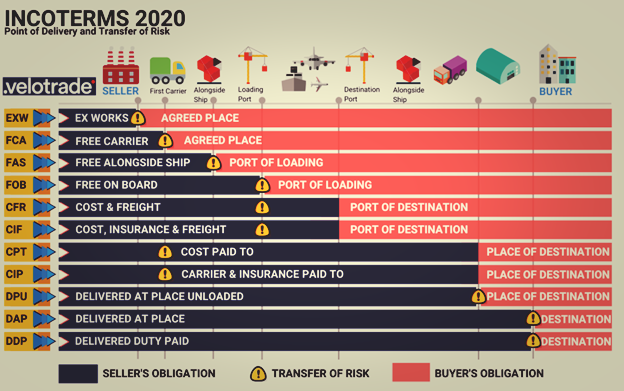
Incoterms are standardized trade terms that define the buyer’s and seller’s responsibilities regarding costs, risk, and delivery points. The 2020 revision includes 11 rules categorized into two groups. The first group includes rules for any mode of transport: EXW (Ex Works), FCA (Free Carrier), CPT (Carriage Paid To), CIP (Carriage and Insurance Paid To), DPU (Delivered at Place Unloaded), DAP (Delivered at Place), and DDP (Delivered Duty Paid). These are especially relevant for multimodal and containerized transport. The second group, FAS (Free Alongside Ship), FOB (Free on Board), CFR (Cost and Freight), and CIF (Cost, Insurance, and Freight) is reserved for sea or inland waterway transport, more suitable for bulk cargo. Each rule clarifies the point of delivery, risk transfer, cost-sharing, and documentation responsibilities. However, they do not define when title or ownership transfers.
Despite their widespread use, Incoterms are often misunderstood. A frequent mistake is using sea transport rules like FOB or CIF for container shipments, which exposes sellers to unnecessary risks, particularly when goods are damaged before being loaded on the vessel. In the Sendai case, companies using FOB were liable for containers lost or damaged before loading. In contrast, terms like FCA or CIP would have transferred risk earlier in the supply chain. Another issue is the assumption that Incoterms cover title transfer, which they do not. Ownership terms must be clearly defined in the sales contract, separate from the delivery obligation. Additionally, vague contract references such as “FCA Chicago” can lead to disputes, as large cities may have multiple freight terminals. Contracts must clearly specify locations and facilities. Certain Incoterms also pose logistical problems in specific contexts. For instance, using EXW in countries where sellers are required to handle export clearances can be unworkable. Opting for DDP without verifying that the seller can legally pay import taxes in the buyer’s country often results in delays and compliance issues.
When using letters of credit (LCs), the seller must usually present a transport document to secure payment. Terms that involve delivery to a carrier, such as CIF, CIP, CFR, and CPT, are most compatible with LC requirements, as they provide the necessary documentation like a bill of lading or airway bill. Conversely, terms like FCA or DAP may not always provide the transport documents required by banks, especially if the goods are handed over at a warehouse or inland terminal. Understanding this distinction is critical to ensuring that your Incoterm selection supports your financing structure rather than complicating it.
While originally intended for international trade, Incoterms are increasingly being used in domestic transactions, particularly within customs unions like the European Union or in cases where logistics coordination benefits from standardized risk allocation. The core principles remain unchanged: defining who arranges transportation, who bears the cost, and when the risk transfers. However, they don’t address customs duties unless relevant, and users should always confirm the local legal interpretation of the selected term.
o minimize disputes and ensure compliance, exporters and importers must adopt structured best practices for applying Incoterms. The International Chamber of Commerce (ICC) recommends embedding the chosen Incoterm directly within the sales contract and commercial invoice, specifying the version year (e.g., “Incoterms® 2020”) to avoid legacy confusion — a step that reduces interpretation errors by up to 60%. Companies with digitized trade workflows using electronic bills of lading (eBLs) and AI-enabled contract management systems have reported a 30–40% drop in documentation disputes, according to UNCTAD’s Digital Trade 2024 Report. Training plays a decisive role: exporters certified under ICC’s “Incoterms Mastery Programme” exhibit 25% fewer customs clearance delays. Additionally, using trade analytics to simulate cost implications under different Incoterms (such as comparing CIF vs. DAP) helps optimize freight and insurance expenses — yielding 3–5% cost savings per shipment, based on World Bank logistics efficiency studies. Finally, collaboration between finance, logistics, and legal teams during contract drafting ensures alignment on payment, risk, and delivery obligations, reinforcing the core goal of Incoterms — clarity, consistency, and trust in global trade transactions.
It’s critical to reiterate that Incoterms do not determine when ownership or title transfers. This must be separately negotiated and specified in the contract. Title is especially relevant in areas like financial accounting (revenue recognition), customs clearance, and insurance claims. On the subject of insurance, only CIF and CIP require the seller to procure insurance for the main carriage. Even then, the minimum insurance coverage mandated is often insufficient. For example, CIP requires coverage compliant with Clause A of the Institute Cargo Clauses, while CIF mandates only the more limited Clause C. In practice, buyers and sellers often agree to supplementary clauses that expand or clarify insurance responsibilities. Additionally, Incoterms refer to transport-related security, and sellers are obligated to comply with security measures under applicable international standards like the ISPS Code. Ensuring that your logistics partners and freight forwarders understand these responsibilities is key to maintaining compliance and minimizing risk exposure.
Incoterms are flexible, but any modifications must be clear and unambiguous. It is acceptable to append qualifiers to tailor the rules to specific commercial needs. For instance, “FOB, stowed” indicates that the seller also bears the cost of stowage, while “EXW, loaded” clarifies that the seller will place the goods on the truck. “DDP, VAT unpaid” can be used where the seller agrees to pay duties but not local taxes. However, vague or undefined terms like “liner terms” or “gross terms” should be avoided unless properly explained, as they can introduce ambiguity and open the door to disputes.
Choosing the right Incoterm is not simply a contractual checkbox. It’s a strategic decision that affects everything from pricing to delivery timelines, from risk exposure to documentation flow. Whether you’re a first-time exporter negotiating a D2C shipment or a multinational procurement manager overseeing complex supply chains, using Incoterms correctly can protect your interests, reduce liabilities, and enhance customer satisfaction. With resources like the ICC Incoterms handbook, digital apps, and training modules now readily available, businesses have the tools they need to move from vague assumptions to precise, risk-aware trading practices. In a world where supply chain resilience is more important than ever, there’s little room for guesswork.
The views expressed do not represent the company’s position on the matter. Stay informed through Nitisara Platform and Blogs and adapt to emerging trends are poised to thrive in the competitive global marketplace. – https://nitisara.org/category/blogs-updates/
References:-