What is a Bill of Lading?
By admin
/ March 19, 2024
In the dynamic realm of international trade, the ‘bill of lading’ holds a pivotal role in ensuring the smooth transportation…
Read More


By Nitin Yadav, Researcher, NITISARA
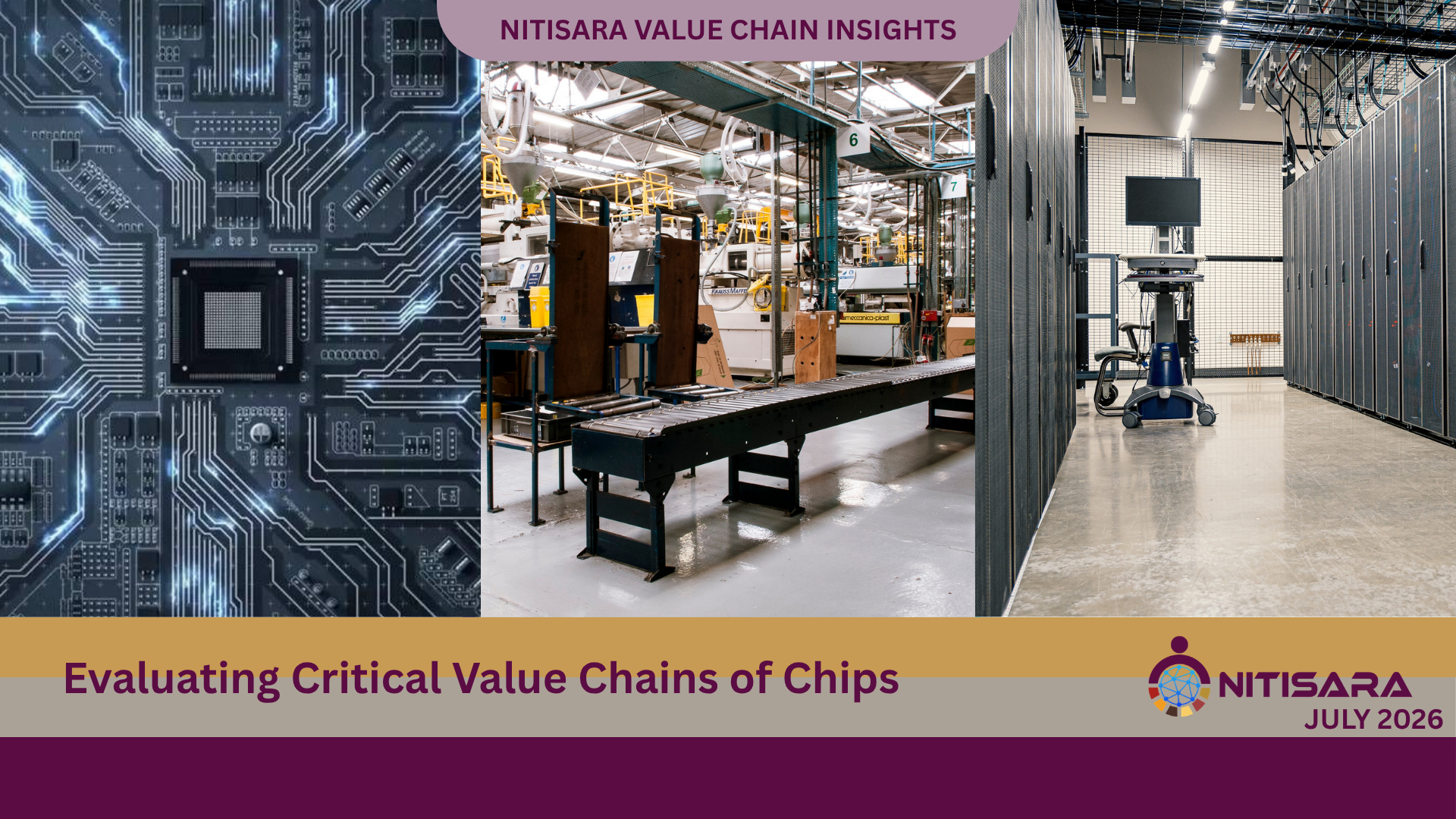
The global semiconductor market is forecasted to reach USD 1 trillion by 2030. In India, the semiconductor market was valued at about USD 38 billion in 2023, rising to USD 45–50 billion in 2024–25, and expected to more than double to USD 100–110 billion by 2030. This blog will explore India’s evolving semiconductor supply chain, examining its current challenges, the critical role of international cooperation, and the policy frameworks and infrastructural developments driving India’s ambition to become a global semiconductor hub.
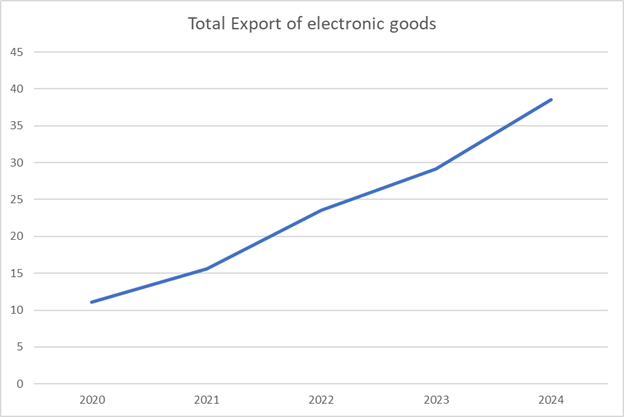
With smartphones, Crypto mining, GPUs, Defence systems, Data centres, and Electric cars. The world of Electronics is flourishing at a rapid pace, and India is emerging as a future hub for the electronics goods supply chain, especially for semiconductors. For the past 5 years, India’s export of electronic goods has been growing phenomenally with a CAGR of 28%. India’s semiconductor consumption is growing at a CAGR of roughly 13%–15% during the period 2025-2030. Growth is driven by increasing adoption of consumer electronics, 5G, IoT, AI, electric vehicles, and government policies like production incentivesAs many countries are in demand for semiconductors, batteries, diodes, and other electronic goods, due to their fast development in the field, due to a lack of enough countries keeping up the supply chain can strain their cash flow and hinder growth. With the help of a lot of planning, ambition, and government policies, India is setting itself up to be an important player in the future semiconductor supply chain.
The COVID-19 pandemic, geopolitical tensions, and natural disasters exposed critical weaknesses: when key fabrication hubs or raw material sources are disrupted, downstream industries (automobiles, consumer electronics, etc.) suffer large delays and cost escalations. Taiwan, South Korea, Japan, China, and the U.S. currently dominate semiconductor fabrication. For example, Taiwan produces over 60% of the world’s semiconductors, including nearly 90% of the most advanced nodes. India’s share of wafer fabrication capacity remains very modest (close to 0.1% globally). The Indian government has committed ₹76,000 crore under incentive schemes to support semiconductor fabrication, display manufacturing, and design. In India, more than ₹1.55 lakh crore in industry investments have already been committed by firms (domestic and foreign) towards building capacity in India’s semiconductor supply chain.
India is now the 21st biggest exporter of electronic goods, and the top 5 consists of China, Hong Kong, Taiwan, the USA, and South Korea. India’s biggest markets are the USA, the United Arab Emirates, the Netherlands, the UK, and Italy.
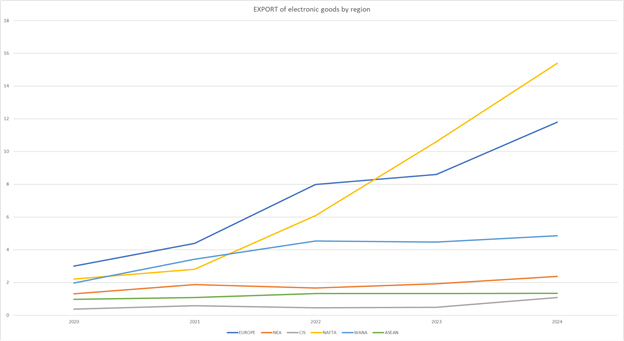
In India, the electronics industry is turning out to be one of the fastest-growing industries. It is estimated that India’s exports will triple to USD $835 billion by 2030, from US$431 billion in 2023, at a compound annual growth (CAGR) rate of 24 percent. Exports of electronics are anticipated to rise from US$28 billion in 2023 to US$61 billion in 2030.
Semiconductors are undeniably the next big thing in the electronics world, completely changing how we design and use our gadgets. They’re the backbone of high-speed computers, smartphones, and AI systems, acting as the heart of the next generation of tech. As the world moves towards more resilient and diverse supply chains, semiconductors are essential for innovation and economic strategy in many countries. India is already making impressive progress in the electronics supply chain, so we must seize this opportunity to strengthen our position in the semiconductor landscape, ensuring growth, added value, and global competitiveness in the electronics market. Developing semiconductors domestically is essential for the Indian government’s goal of building a local electronics supply chain and reducing reliance on foreign nations, particularly China, which, despite its hurdles, remains a major manufacturing hub. India is at a crucial juncture to jump into electronics manufacturing, as semiconductor chips are vital for all electronic devices. With more companies seeking to diversify their production, India has a fantastic opportunity to position itself as a dependable alternative to the current manufacturing giants.
1. Supply Chain Diversification: The U.S., EU, India, and Japan launched major initiatives to onshore or “friendshore” semiconductor capacity.
2. Risk Mapping & Digital Visibility: Leading firms like Intel and TSMC adopted AI-based risk dashboards that map supplier dependencies across tiers. Using predictive analytics, Intel reduced procurement risk exposure by 17%, and improved raw material forecast accuracy by 22%.
3. Regional Integration & Trusted Networks: Countries are shifting toward “trusted trade corridors”, e.g., the Indo-Pacific Economic Framework (IPEF) focuses on resilient supply chains for critical goods (semiconductors, clean energy components, pharmaceuticals). Japan and the U.S. established a joint task force on semiconductor raw material security, creating redundancy in neon and palladium sourcing.
4. ESG-Linked Resilience: Investors now evaluate supply chain resilience alongside ESG metrics. In 2024, over 65% of listed semiconductor firms disclosed climate-related supply chain risks in their annual reports, up from 48% in 2021. Green manufacturing (e.g., low-carbon fabs, circular waste reuse) is being integrated into resilience planning to meet EU Carbon Border Adjustment Mechanism (CBAM) compliance.
Because of its lack of fabrication facilities, India is one of the biggest importers of semiconductors and electronic goods from around the world. The Indian semiconductor market was valued at USD 26.3 billion in 2022. If the market keeps on growing at such a great pace, with a forecasted CAGR for 2022-2032, India can grow to 271.9 billion USD by 2032. Exports in 2023 were $2.07B, with the world ranking of 32. Our biggest destination was the USA, importing the majority of our exports ($1.96 billion), followed by Somalia and then Thailand, but still, we only share 1.34% of global exports, with China being the majority player in the field. However, our imports for semiconductors outweigh our exports multiple times. In 2023 alone, we imported $6.73B worth of semiconductors, with $ 3.83 billion just being from China alone.
Despite engaging in semiconductor design and outsourcing manufacturing to countries like China, Taiwan, the USA, and a few European nations, India remains heavily reliant on imports and is primarily involved in the design, assembly, testing, and packaging stages of semiconductor production.
Competition: India is surrounded by countries like China, Taiwan, and Hong Kong that have been performing great in the semiconductor field for a long before. The majority of electronics imports in the world are dominated by these countries, and for India to compete with them comes as a challenging wall to progress. India imports more semiconductors from China(3.83B) alone than it exports in total (2.07B). We can’t compete with them instantaneously, it will be something that will be overcome with time as we grow our semiconductor supply chain
Raw material: India imports most of its raw material required from China, Taiwan, and Hong Kong. Our heavy dependency on these countries can disrupt our supply chain.
Ecosystem: India currently lacks a comprehensive ecosystem for raw materials, high-purity chemicals, etc, that are needed for the production of semiconductors. The lack of fabrication facilities in India also acts as a disadvantage; we have yet to make a semiconductor fabrication plant.
India has been able to form MOUs with several countries. India made an MOU with the EU in nov 2023 on Working Arrangements on Semiconductors Ecosystems, its supply chain, and innovation under the framework of the EU-India Trade and Technology Council (TTC). The MoU intends to strengthen cooperation between India and the EU towards the enhancement of semiconductors for the advancement of Industries and digital technologies. India also made an MOU with the USA, Singapore, and Japan to seek to establish a collaborative mechanism between the two governments on Semiconductor Supply chain resiliency and diversification.
Government policies play a crucial role in making an industry grow and make it internationally competitive with subsidies, infrastructural development, R&D support, and trade support. According to the Indian government, the India Semiconductor Mission (ISM), formed in 2021, aims to build a strong semiconductor and display ecosystem, positioning India as a global hub for electronics manufacturing and design, while serving as the nodal agency for the efficient and seamless implementation of semiconductor and display schemes.
In conclusion, the Indian semiconductor supply chain is an emerging phase and is one of the fastest-growing fields in India; if shown good guidance can make it compete against giants in the field like China. India won’t become a semiconductor giant in a day, but by focusing on speedy execution of project, building confidence for investment, building infrastructure, making policy stability for fast growth the sector will help the country’s economy, India can emerge as a major player in the global semiconductor value chain over the next 10–15 years.
The views expressed do not represent the company’s position on the matter. Stay informed through the Nitisara Platform and Blogs, and adapt to emerging trends that are poised to thrive in the competitive global marketplace.- https://nitisara.org/category/blogs-updates/
References