What is a Bill of Lading?
By admin
/ March 19, 2024
In the dynamic realm of international trade, the ‘bill of lading’ holds a pivotal role in ensuring the smooth transportation…
Read More


By Tanmay Goel, Researcher, Nitisara
India’s critical mineral value chains represent a strategic imperative for the nation’s economic transformation and trade competitiveness. With high import dependency for essential minerals like lithium, cobalt, and nickel, India faces significant supply chain vulnerabilities that directly impact its transition to clean energy and advanced manufacturing. The government’s recent launch of the National Critical Mineral Mission (NCMM) with an investment of ₹34,300 crore signals a comprehensive approach to developing domestic capabilities while diversifying international partnerships.
Critical minerals have emerged as the new cornerstone of global economic power, fundamentally altering trade relationships and industrial competitiveness in the 21st century. For India, these minerals—including lithium, cobalt, nickel, rare earth elements, and copper—are not just raw materials but assets that determine the nation’s ability to participate in the global clean energy transition and technological advancement. The Ministry of Mines has identified 30 minerals essential for India’s economic development, spanning applications from electric vehicle batteries and solar panels to defense systems and telecommunications infrastructure. As the world’s third-largest energy consumer, India’s demand for these minerals is projected to grow exponentially, with estimates suggesting a 5.4-fold increase in copper demand and 10.7-fold increase in nickel demand by 2047 to support the country’s net-zero emissions pathway.
The trade implications of India’s critical mineral dependencies are profound and multifaceted. Currently, India’s critical mineral imports have surged from $475 million in FY15 to $4.93 billion in FY24, showing a more than 10-fold increase that underscores the nation’s growing reliance on external sources. This growth in import volumes has altered India’s trade balance and exposed the economy to supply chain disruptions, price volatility, and geopolitical tensions. China’s dominance in critical mineral processing—controlling 87% of rare earth processing, 73% of cobalt processing, and 68% of nickel processing—has created a vulnerability that goes beyond economic considerations to encompass national security implications.
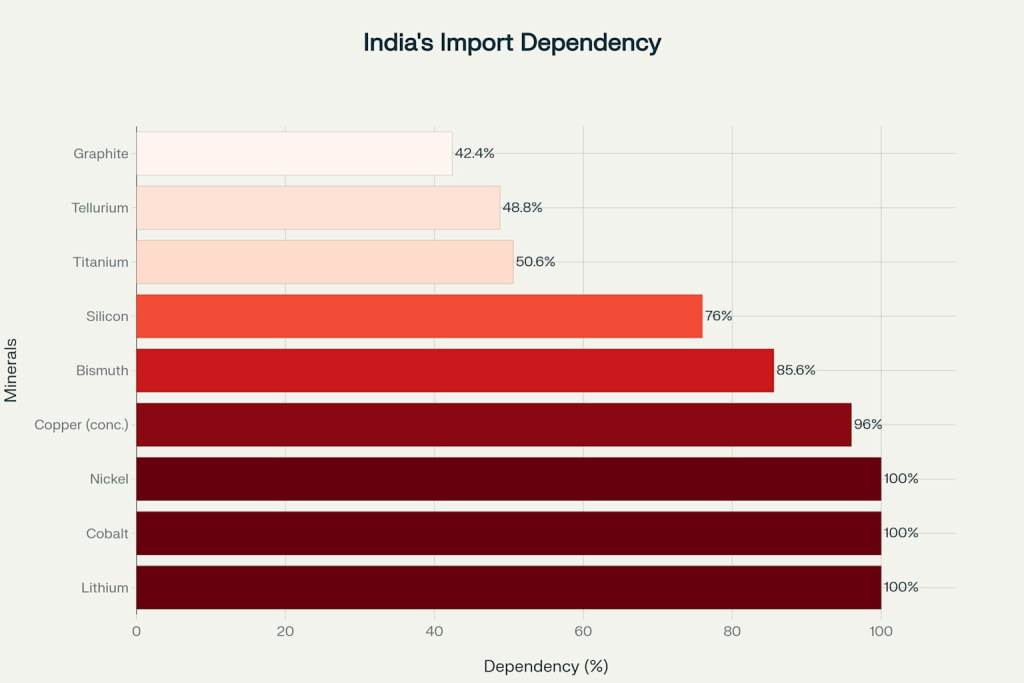
India’s Import Dependency for Critical Minerals (Percentage-wise), Source: Author’s Own
India’s critical mineral import dependency has created major structural challenges for the nation’s trade balance and economic security. The country maintains 100% import dependency for lithium, cobalt, and nickel—three minerals absolutely essential for electric vehicle batteries and renewable energy storage systems. Beyond these, India exhibits high dependency rates for other critical minerals: bismuth (85.6%), silicon (76%), titanium (50.6%), tellurium (48.8%), and graphite (42.4%). This dependency implies substantial financial outflows, with battery packs alone accounting for 68% of India’s total critical mineral imports in FY24, up from 44.5% in FY15.
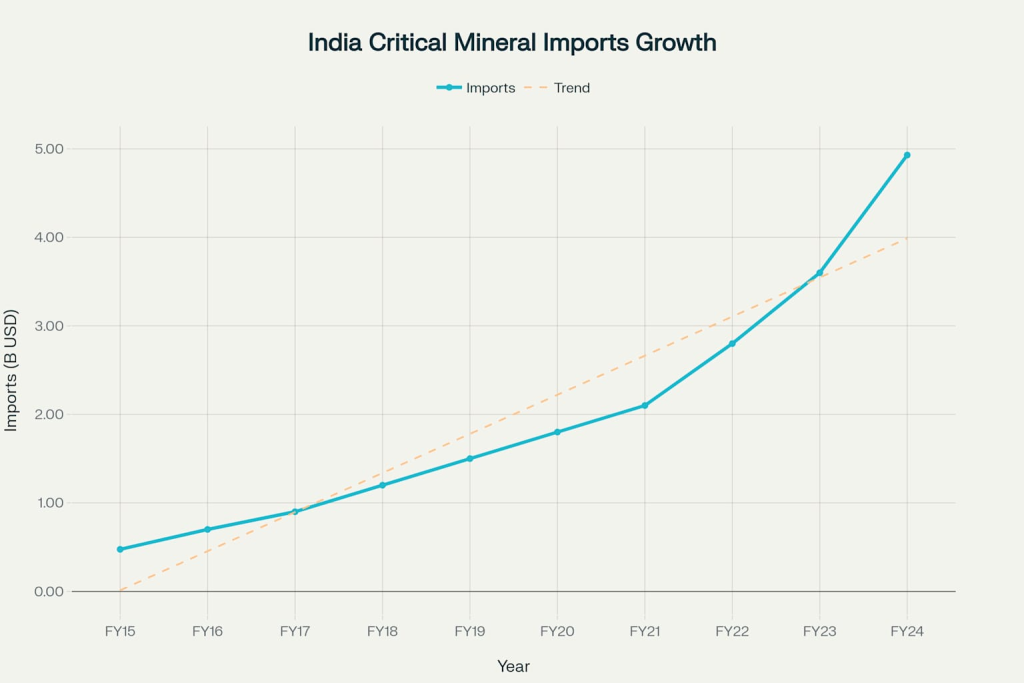
India’s Critical Mineral Imports Growth (FY15-FY24), Source: Author’s Own
The economic implications extend beyond immediate trade deficits. China’s 56.3% share in India’s total critical mineral imports creates a vulnerability that affects multiple sectors simultaneously. When China imposed restrictions on rare earth magnet exports, it directly threatened India’s growing electric vehicle sector and highlighted the fragility of concentrated supply chains. The situation is further complicated by the fact that India sources critical minerals from countries with varying degrees of geopolitical risk, including Russia, Madagascar, Indonesia, and Peru, creating multiple potential points of supply disruption 5.
From a trade security perspective, this dependency undermines India’s autonomy in key sectors. India’s ambitious targets—including 500 GW of renewable energy capacity by 2030 and achieving net-zero emissions by 2070—are directly contingent on securing reliable access to critical minerals. Any disruption in supply chains could derail these commitments, affecting India’s international climate commitments and its position in global climate negotiations. Moreover, the price volatility of critical minerals, often driven by supply-side constraints and geopolitical tensions, creates unpredictable cost structures for Indian manufacturers, affecting their global competitiveness.
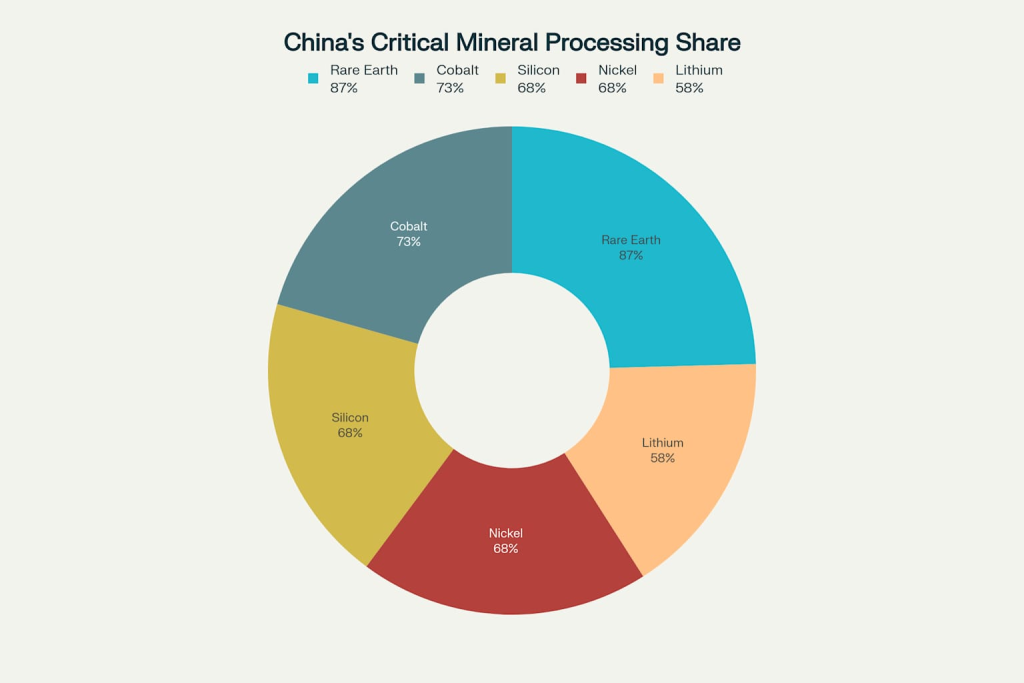
China’s Share in Global Critical Mineral Processing (%), Source: Author’s Own
India’s National Critical Mineral Mission (NCMM) is engineered as a seven-pillar programme that stitches together exploration, mining, processing, recycling, trade facilitation, research, and skilled-manpower development into a single, whole-of-government framework. On the upstream side, the Mission mandates 1,200 domestic exploration projects and the auction of more than 100 critical-mineral blocks by 2030-31, while simultaneously empowering public-sector enterprises and private firms—through the vehicle of Khanij Bidesh India Ltd (KABIL)—to secure at least 50 overseas mining assets 7. These parallel tracks are designed to convert India from a price-taking raw-ore importer into a resource-owning participant that can influence supply terms and hedge against geopolitical shocks. Complementing new mine supply, the Mission earmarks funding for four integrated mineral-processing parks and three Centres of Excellence, breaking the historic pattern in which India exported low-value ore and re-imported refined metals at a premium. By domesticating beneficiation and hydrometallurgical capacity, the Mission aims to capture higher value-addition stages, lower import bills, and embed indigenous content in downstream industries such as battery manufacturing and high-performance magnets.
Mid-stream resilience is further strengthened through an explicit recycling and circular-economy pillar, including an incentive scheme to recover 400 kt of critical materials from industrial waste and end-of-life products 7. This widens feedstock diversity, flattens demand spikes, and creates a secondary-materials market that feeds directly into the new processing hubs. On the market-linkage front, the NCMM authorises “Critical Mineral Partnership Agreements” within free-trade pacts, harmonises HS codes, and eliminates import duties on strategic inputs—an approach that lowers logistical friction while simultaneously building a national stockpile of five essential minerals as a buffer against supply disruptions 7. All of these interventions are overseen by an Empowered Committee chaired by the Cabinet Secretary, giving the Mission a high-level coordination mechanism to align fiscal incentives, trade policy, R&D funding, and human-capital programmes. Taken together, these measures re-wire India’s value chain from a linear, import-dependent system into a vertically integrated, circular, and internationally networked ecosystem that can support the country’s ambitions in renewable energy, electronics, and advanced manufacturing.
India’s strategic partnerships in critical minerals are fundamentally reshaping its trade dynamics and creating new geopolitical alignments in the global economy. The India-Australia partnership exemplifies this transformation, with the Memorandum of Understanding between KABIL and Australia’s Critical Mineral Office creating a framework for joint investment in lithium and cobalt mining assets 8. Australia’s position as a leading lithium producer accounting for over 35% of global lithium extraction, makes this partnership strategically vital for India’s Electric Vehicle and renewable energy ambitions 4. Similarly, the emerging India-Chile relationship, with discussions on a Comprehensive Economic Partnership Agreement (CEPA) focused on critical minerals, signals a new model of trade agreements that prioritize strategic resource access alongside traditional commercial considerations.
These partnerships are creating alternative supply chains in critical minerals, with the India-Australia collaboration including technology transfer agreements and joint development of processing capabilities. India’s participation in initiatives like the Mineral Security Partnership demonstrates its commitment to building resilient, diversified supply chains with like-minded democracies, while joint research initiatives on sustainable mining practices and circular economy approaches are creating new export opportunities for Indian expertise and technology solutions in knowledge-intensive aspects of critical mineral trade.
In conclusion, India’s critical mineral value chains represent both a strategic challenge and a transformative opportunity that will define the nation’s economic trajectory and trade relationships for decades to come. The current reality of overwhelming import dependency creates vulnerabilities that extend beyond economic considerations to encompass national security, technological sovereignty, and climate commitments, but the comprehensive response embodied in the National Critical Mineral Mission and strategic international partnerships suggest India is positioning itself to fundamentally alter its role in global critical mineral value chains. As India develops domestic processing capabilities, secures overseas mining assets, and builds alternative supply chains through partnerships with countries like Australia and Chile, it is creating new patterns of global trade that reduce systemic risks while opening new avenues for trade in secondary materials and environmental technologies. The country’s success in critical mineral value chains will determine its competitiveness in key growth sectors including electric vehicles, renewable energy, and advanced manufacturing, with the ultimate measure of success being the creation of a strong, sustainable, and economically feasible critical mineral ecosystem that supports India’s broader development objectives while contributing to global supply chain stability and the clean energy transition.
The views expressed do not represent the company’s position on the matter. Stay informed through Nitisara Platform and Blogs and adapt to emerging trends are poised to thrive in the competitive global marketplace. – https://nitisara.org/category/blogs-updates/