What is a Bill of Lading?
By admin
/ March 19, 2024
In the dynamic realm of international trade, the ‘bill of lading’ holds a pivotal role in ensuring the smooth transportation…
Read More


By Palak Bhagasra, Researcher, Nitisara
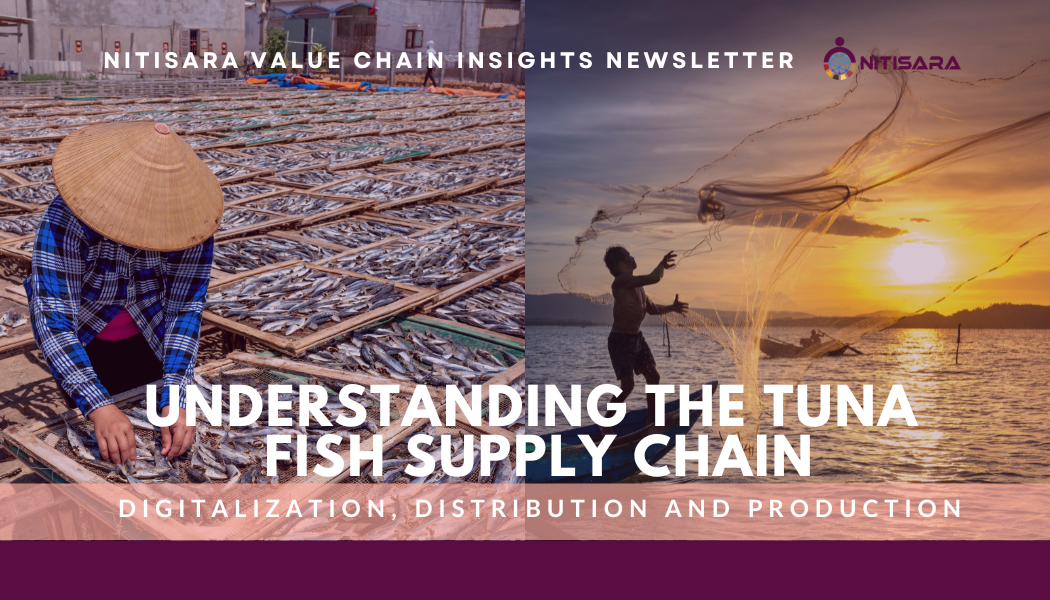
Tuna ranks among the most commercially significant and nutritionally valuable seafood products globally. Its demand spans premium fresh and sashimi-grade offerings to mass-market canned varieties. The tuna supply chain is a complex network that spans the open ocean, processing plants, refrigerated logistics systems, international trade regulations, and retail endpoints. This blog explores each stage in depth—from fishing methods and sustainability frameworks to modern processing techniques, cold-chain logistics, trade barriers, digital traceability, and India’s rising role in the global tuna trade. Through this examination, we highlight the convergence of ecological stewardship, technological innovation, and economic opportunity within a rapidly evolving seafood ecosystem.
Tuna is one of the most prized seafood commodities around the world, featuring heavily in cuisines ranging from Japanese sashimi to European canned pantry staples. Globally, tuna production exceeds seven million tonnes per year, supporting countless livelihoods and trade pathways. Its high protein content, long shelf life when properly processed, and use across multiple culinary segments make it highly versatile and profitable. However, tuna stocks face overfishing, habitat degradation, and increasing consumer demand—challenges that necessitate careful supply chain governance. The journey from ocean to plate involves a multifaceted chain: fishers who risk sea voyages; technology-enabled processing plants striving to meet international standards; reefer logistics operations safeguarding product integrity; certification systems assuring sustainability; and retailers and wholesalers catering to consumer preferences. India, as a maritime nation with over 7,500 km of coastline and emerging port infrastructure, has begun to leverage its geographic and human capital to become a growing player in tuna exports. Yet, it must navigate policy shifts, cold-chain gaps, and sustainability imperatives.
Tuna are primarily caught through purse seining, longlining, and pole-and-line fishing—methods that vary in efficiency, species target, bycatch rate, and energy intensity. Purse seining, heavily utilized in the Pacific and Indian Oceans, deploys large nets around schools of tuna. It is efficient for large catches but often results in bycatch of juvenile fish and other marine life, raising ecological concerns. To improve catch efficiency and reduce bycatch, Fish Aggregating Devices (FADs) are deployed—floating structures that concentrate fish. However, FADs contribute to marine pollution and unintended catch, prompting regulatory scrutiny. Longlining uses lengthy lines with baited hooks spaced over vast oceanic areas and targets specific tuna species like yellowfin and bigeye. While more selective, longliners require longer voyages and consume more fuel, increasing costs. Conversely, pole-and-line fishing operates with rods and live bait, capturing tuna one at a time. Though labor-intensive, this method offers high sustainability credentials and minimal bycatch. In countries like India, traditional gill nets and small-scale mechanized vessels are commonly used, particularly in Kerala, Tamil Nadu, and Lakshadweep. As India modernizes its fleet, subsidies are being introduced to shift vessels toward more sustainable gears and enhance catch quality.
Ecological governance plays a central role in managing tuna stocks. The United Nations Convention on the Law of the Sea (UNCLOS) creates the legal framework for marine resource rights, while Regional Fisheries Management Organizations (RFMOs) such as the Indian Ocean Tuna Commission (IOTC) set catch quotas, define fishing seasons, and monitor compliance within broader oceanic zones. Governments like India have implemented measures such as the 61-day monsoon trawl ban and Vessel Monitoring System (VMS) mandates to prevent overexploitation near coastal waters. These steps preserve tuna stocks and also support international certification schemes like the Marine Stewardship Council (MSC), which helps producers access premium global markets and assure consumers of sustainable sourcing. Despite this progress, challenges remain—enforcing regulations across sprawling maritime territories, tracking small artisanal vessels, and balancing economic benefits with long-term ecological health.
Once tuna are caught, immediate preservation is crucial to forestall bacterial deterioration and maintain quality—especially for sashimi-grade or fresh-chilled products where color, flavor, and texture are paramount. Onboard rapid icing remains a widely used method suitable for local, short-haul landings. However, moisture infiltration and inconsistent temperatures limit its effectiveness over longer durations. This has prompted a shift toward ultra-low temperature freezing—typically at –60°C—immediately after capture. This process, developed for Japanese sashimi markets, preserves the tuna’s original qualities and can maintain fish in near-fresh condition for months. Mechanized vessels headed for export markets now increasingly adopt this technology.
After docking, tuna are transported to processing facilities where they undergo sorting by species and size, manual or machine gutting, filleting, and, in some cases, thawing for immediate sale as steaks or sashimi blocks. For canned tuna, the fish is cooked, cleaned, drained, vacuum-sealed in cans, sterilized, and coded before boxed for distribution. Leading tuna processors in Thailand, Spain, and the Philippines utilize automation and AI-powered quality control systems to inspect can seam integrity, bruising, and contaminants. These systems reduce human error and enhance throughput. India is gradually upgrading its infrastructure, particularly in the Andaman & Nicobar Islands’ processing zones, where subsidized vessel upgrades and facility enhancements aim to process high volumes to meet export standards. Nonetheless, these processing nodes must adhere to stringent food safety certifications such as HACCP (Hazard Analysis and Critical Control Points) to be competitive globally.
Transporting tuna from its point of processing to global markets demands a meticulously maintained cold chain, often stretching across continents. Ultra-low temperature reefer containers are the industry standard for frozen sashimi-grade tuna, capable of sustaining –60°C and equipped with Remote Container Management (RCM) systems for temperature logging, GPS tracking, and damage alerts. The voyage from processing plant to shipping port typically ends aboard cargo vessels headed to major hubs such as Thailand’s Laem Chabang, Spain’s Vigo, or Canada’s Vancouver.
For value-added fresh tuna (e.g., sushi-grade), air freight is preferred despite higher costs, because speed preserves quality and fetches premium prices in markets like Japan, the EU, and North America. India still relies heavily on air routes for its nascent sashimi-grade shipments, though cold storage at regional airports and refrigerated trucking to hubs in Chennai, Kochi, and Mumbai is being strengthened. Within domestic markets, reefer trucks distribute chilled and frozen tuna to urban centers, supermarkets, and hotels. The integrity of the cold chain is critical—any breach can cause microbial growth, weight loss from dehydration (drip loss), or quality degradation, leading to waste and financial loss. For this reason, drugs-grade sensors and blockchain-based temperature monitoring are being deployed within cold-chain systems, ensuring that each point of transfer is logged and digitally verified.
Tuna supply chains are under increasing pressure to deliver transparency in sourcing, sustainability, and labor conditions. Blockchain has emerged as a powerful tool to meet these demands. By embedding each fish’s journey—from catch vessel identity, location coordinates, fishing gear used, processing timestamps—to a unique QR code on packaging, traceability systems are making the supply chain more accountable and consumer-friendly. Companies like Bumble Bee Foods in the U.S. and Thai Union have implemented these systems successfully. Indian seafood startups are piloting similar platforms, emphasizing supply chain transparency and regulatory compliance. Blockchains also reinforce sustainability by verifying certifications like MSC and providing immutable audit trails. Such traceability is increasingly vital as regulatory agencies worldwide impose strict import rules and consumers demand eco-conscious products. Combined with eco-labels and digital provenance tools, blockchain initiatives can unlock value premiums for sustainably caught and transparently processed tuna.
Ecological viability remains the bedrock challenge. Overfishing, illegal discards, and habitat degradation risk depleting tuna stocks. India must strengthen enforcement in its EEZ, scale VMS on artisanal vessels, and more tightly integrate with RFMO quota systems. Cold chain infrastructure also needs development—especially regionally—and modernization of local transport routes to prevent losses in transit and ensure product remains fit for export standards. Economically, building scale in processing while achieving cost efficiencies will require automation and skill upgradation. Adoption of high-speed canning lines, automated QC systems, and staff training in sanitation protocols is essential to compete with global players like Thailand and Spain. Consumer perception challenges also persist—many still view tuna as a canned commodity rather than a high-quality or sustainable product. Branding, certification, and digital traceability must reshape perceptions to support domestic premium markets and export segments.Opportunities, however, abound: blockchain-enabled exports can fetch price premiums in eco-sensitive markets; eco-labeling can differentiate Indian tuna; IoT-guided fishery advisories can reduce operating costs; and additive-value segments like sushi-grade and ready-to-cook offerings can yield higher margins. With global seafood demand projected to grow, India’s exportable potential could exceed USD 1 billion annually in tuna—provided supply chains are resilient, traceable, and governed sustainably.
India has an annual marine fish catch of around 14 million tonnes, but value addition through processing remains limited—much of it entering traditional domestic markets. However, investments and policy incentives are creating a pivot: the Andaman & Nicobar Islands have been identified for a strategic tuna export mission, with an estimated potential of over 60,000 tonnes across yellowfin, skipjack, and bigeye species. Subsidies facilitate vessel conversion to freezer-equipped liners, while training programs support fishers with modern gear and sustainability practices. These developments align with India’s broader “Blue Economy” objectives, which augment coastal livelihoods, value-added exports, and maritime domain awareness. India’s fisheries department, alongside INCOIS, issues real-time Tuna Fishery Advisories using satellite and sea surface temperature data, improving catch efficiency and cut fuel use by reducing futile operations. Despite existing gaps in port processing capacity, cold storage availability, and certification frameworks, India’s growing supply chain integration—fueled by public-private partnerships—is building a credible path to global markets.
The tuna supply chain exemplifies the intricate balance of ecological responsibility, advanced logistics, international trade, and consumer demand. From the ocean’s edge to the dining table, the complexity is vast—yet ripe with innovation. Technologies such as blockchain, satellite-based fishing informs, ultra-low temperature freezing, and remote monitoring systems are shaping a modern tuna ecosystem that can be both profitable and sustainable. India, with its abundant marine resources and intensifying infrastructure investment, is standing at a critical junction. If it can shore up cold chains, ramp up fishing sustainability, build processing hubs, and secure traceability systems, India can emerge as a global tuna powerhouse. Transforming tuna into a sustainable export not only benefits the economy but sets a benchmark in responsible seafood production. As consumers grow more aware of ecological impacts and supply chain transparency, India’s ability to harness its oceanic wealth responsibly will define the tuna industry’s future. Strengthening each link—from boat to plate—is both an economic necessity and an environmental commitment.
The views expressed do not represent the company’s position on the matter. Stay informed through the Nitisara Platform and adapt to emerging trends to thrive in the competitive global marketplace. – https://nitisara.org/category/blogs-updates
References