What is a Bill of Lading?
By admin
/ March 19, 2024
In the dynamic realm of international trade, the ‘bill of lading’ holds a pivotal role in ensuring the smooth transportation…
Read More


By Tanmay Goel, Researcher, Nitisara
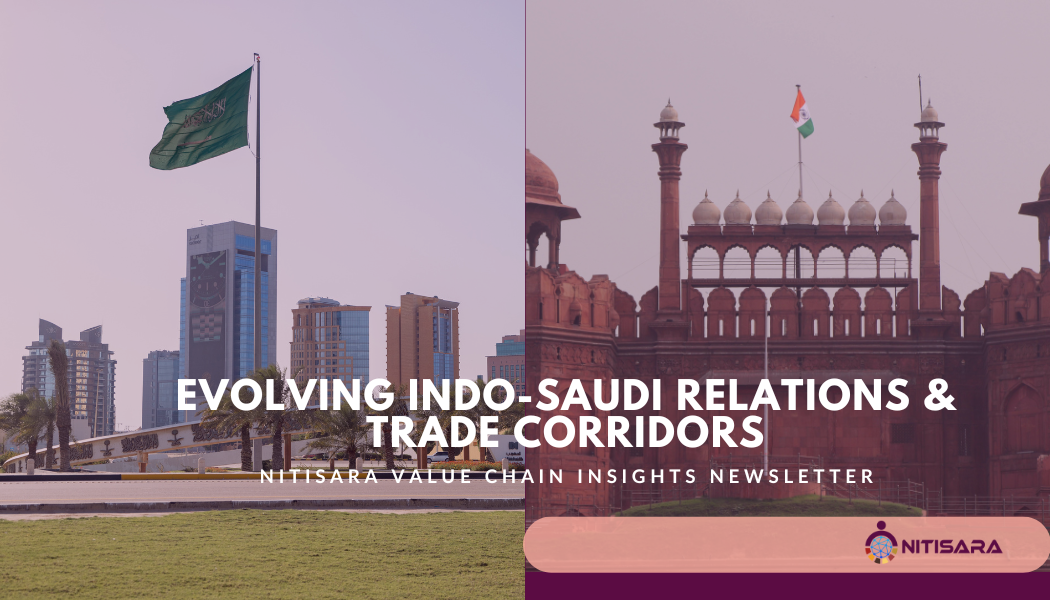
India & The Kingdom of Saudi Arabia bilateral trade has seen significant transformation in recent years from a traditional to a diversified strategic partnership. The cooperation now encompasses technology, defense, renewable energy, and infrastructure collaboration, and bilateral trade reached USD 42.98 billion in FY 2023-24 1. New paradigms for collaboration under Saudi Arabia’s Vision 2030 and India’s development plan have been created through recent diplomatic exchanges.
India-KSA economic relations in the past decade have seen a huge change, from a hydrocarbon-based alliance to a multi-dimensional strategic alliance across a wide range of sectors. This reflects the complementary strengths of the two countries and the bilateral mutual interest in economic diversification and technology upgradation. The fact that Saudi Arabia is India’s fifth-largest trade partner and that India is Saudi Arabia’s second-largest trade partner is a reflection of this bilateral relationship’s strategic importance.
The alliance has achieved historic momentum since the formation of the Strategic Partnership Council (SPC) in 2019, offering for the first time an institutionalized forum for high-level coordination in the political, security, economic, and investment areas. Recent diplomatic exchanges, especially the co-chairmanship of the second SPC meeting in April 2025, have produced significant agreements across the space cooperation, health, anti-doping, and postal services fields, bearing witness to the expanding sphere of bilateral cooperation beyond the conventional trade boundaries.
India-Saudi Arabia Bilateral Trade Trends (FY 2019-20 to FY 2023-24)
The bilateral trade relationship is diversifying considerably as the two countries align their economic strategy with long-term development goals. While Saudi Arabia remains India’s third-largest crude oil source with 14.3% of total crude imports worth USD 22.08 billion in FY 2023-24, the trade basket has increased significantly 13. India’s biggest exports to Saudi Arabia are motor vehicles and automobiles (16.38% of total exports), Basmati rice, petroleum products, engineering goods, chemicals, textiles, and foodstuffs 2.
Major Trade Commodities: India-Saudi Arabia Export and Import Breakdown
The diversification trend is most pronounced in emerging industries such as renewable energy, where the two countries have committed to collaborative efforts in solar, green hydrogen, and energy storage technology. The USD 12 billion renewable energy sector investment commitment made by Saudi Arabia to India is the prime example of exactly such a strategic transition towards green energy partnerships. The automotive sector too is humongous in reach with multiple Indian automotive firms leaving a strong imprint on the Saudi market.
The IMEC launched in September 2023 as part of India’s G20 presidency is a game-changer infrastructure project that makes Saudi Arabia a key juncture of the world supply chain. The grand project will create irrevocable connectors between India, the Arabian Peninsula, and Europe through an effectively integrated transport network of ports, rail, road, and pipelines. The corridor is divided into two parts: an eastern corridor between India and the Arabian Gulf and a northern corridor from the Gulf to Europe.
IMEC’s activities have strategic consequences extending beyond making trade easier, offering a cut in traditional shipping times and making the supply chain more resilient. For Saudi Arabia, participating in IMEC aligns with Vision 2030’s vision of becoming the global leader in logistics and logistics hub and to redirect the economy away from hydrocarbons. The project will reduce logistics costs, enhance connectivity and create new sources of cross-investment in infrastructure development among the member states.
The Saudi-India investment environment has been significantly enhanced, with Indian investment within the Kingdom totaling around USD 3 billion through August 2023 1. Major Indian business groups in sectors like management consultancy, construction of buildings, telecom, IT, finance, and pharma have established strong presence within Saudi Arabia. Saudi investment in India has also grown very fast with the Kingdom now investing amounts of up to USD 3.226 billion through 2024 4. High Level Task Force on Investment (HLTF), established to help Saudi Arabia’s USD 100 billion investment commitment to India, has made significant progress in sectors like energy infrastructure and taxation policy. The focus laid on such industries as health care, where Saudi Arabia is seeking to leverage the pharmaceutical potentials of India, is a proof of the complementary economic cooperation between the two countries.
| Sector | Invested Amount(USD Billion) |
| Energy & Renewables | 20.0 |
| Petrochemicals & Refining | 5.0 |
| Technology & Digital | 1.0 |
| Food Processing & Agriculture | 0.5 |
| Pharmaceuticals & Healthcare | 0.4 |
| Defence & Aerospace | 2.0 |
| Tourism & Hospitality | 0.3 |
Sector-wise Saudi FDI in India as of March 2024. Source: Author’s own
The technology dimension of Indo-KSA bilateral trade has also surfaced with both countries valuing the strategic importance of digitalization and innovation. Signing of cooperation agreements on digitization, electronic manufacturing, and emerging technologies is a sign of growing focus on technology-led cooperation. Artificial intelligence, cybersecurity, semiconductors, digital infrastructure, e-health, and e-learning are some of the cooperation areas. The startup economies of the two countries have formed official associations through government-to-business relations in the form of transactions to promote knowledge transfer and joint ventures in recycling electronic waste, research on e-planes, and fintech innovation. The Saudi Arabia Public Investment Fund has also placed its faith in India’s information technology industry with significant investments. The recently signed MoU between Saudi Arabia’s Communications, Space and Technology Commission and Telecom Regulatory Authority of India further strengthens regulatory cooperation in the digital economy.
In conclusion, the Indo-KSA trade relationship is at a crucial point, characterized by diversification on strategic lines, technological collaboration, and institutionalization. While both countries’ two-way trade remains to reach all-time highs and new avenues for collaboration have been established through the Strategic Partnership Council, both countries will be seeking to capitalize on emerging opportunities in renewable energy, technology, infrastructure, and defense. With the success of the IMEC programme supplemented by sustained high-level political support and increased private sector participation, Indo-KSA economic cooperation can only be deepened and intensified in the forthcoming years. As both nations have their own development aspirations, the complementary competitiveness and mutual interests form a strong foundation for sustained growth in bilateral trade and investment relations.
References:
The views expressed do not represent the company’s position on the matter. Stay informed through Nitisara Platform and Blogs, and adapt to emerging trends that are poised to thrive in the competitive global marketplace. – https://nitisara.org/category/blogs-updates/