
Deep dive into the Toluene Chemical global value chain
With the globalization of trade in the 20th century, toluene became a globally traded chemical. Its production and distribution became more streamlined, with various countries contributing to the global supply. In the post-World War II Period, the demand for toluene increased substantially as the industries expanded and new applications for toluene emerged. It became a vital component in the production of plastics, synthetic fibers, and resins. In recent years, concerns about the environmental and health impacts of toluene has emerged. Some of the global standards and regulatory measures were implemented to address these issues, leading to changes in production processes and usage.
Author: Saniya Banerjee, researcher, NITISARA
In the contemporary times, Toluene continues to be an important industrial chemical. It is produced and traded on a global scale, with major producers including countries like the United States, China, and various European nations. The future of the toluene trade may be influenced by ongoing developments in technology, environmental regulations, and changes in industrial practices. As industries evolve and new applications for toluene emerge, its trade dynamics are likely to adapt accordingly.
Also known as Toluol, Methylbenzene, Phenyl methane, and a Chemical reference number (CAS): 108-88-3, Toluene is a clear, colourless liquid with a distinct sweet smell, and it has been an important chemical compound in various industries, including the manufacturing sector and the production of chemicals. The history of trade involving toluene is closely tied to the development of the chemical industry and its applications. Toluene was first discovered in 1837 by a Polish chemist named Filip Walter, who isolated it from crude tolu balsam. The name “toluene” itself is derived from the old name for tolu balsam. The late 19th and early 20th centuries witnessed significant developments in the chemical industry. Toluene became more widely available as the industry shifted towards the use of petroleum as a source for various chemicals. Toluene found applications in various industries, including the production of explosives, dyes, and rubber. It was also a key ingredient in the manufacturing of toluene diisocyanate (TDI), which is used in the production of polyurethane.
STANDARDS and Regulatory measures
There are ‘no globally well recognised standards’ that exist for regulating the amount of toluene allowed in the air of homes. However, the Wisconsin Department of Natural Resources (DNR) has set a residential indoor air action level for toluene at 1,400 parts per billion by volume (ppbv). The action level is considered to be protective of public health. Breathing toluene for a lifetime at 1,400 ppbv is very unlikely to be harmful to people. If toluene concentrations in air are above the action level, it is recommend that taking action to halt exposure. The most people can smell toluene at levels between 160 and 37,000 ppbv. If you can smell the chemical, the level may be too high to be safe. The Wisconsin Department of Natural Resources regulates the amount of toluene that can be released into outdoor ambient air by industries. The Wisconsin drinking water standard is 800 parts per billion (ppb) of toluene.
RELEVANCE OF TOLUENE
Toluene holds significant importance in various industrial applications due to its unique properties. Here are some key areas where toluene is widely used:
- Solvent in Industry: Toluene is a highly effective solvent and is extensively used in the production of paints, coatings, adhesives, and inks. Its ability to dissolve a wide range of substances makes it valuable in these industries.
- Polymer and Resin Production: Toluene is a crucial component in the manufacturing of polymers and resins. It is commonly used in the production of polyurethane and phenolic resins, which are essential in the creation of various plastics and synthetic materials.
- Fuel Production: Toluene is a blending component in gasoline, contributing to its octane rating. It is often used to improve the combustion characteristics of gasoline, enhancing engine performance.
- Explosives Manufacturing: Toluene has historical significance in the production of explosives, such as TNT (trinitrotoluene). Its ability to undergo nitration reactions makes it a key ingredient in the synthesis of explosive materials.
- Chemical Intermediary: Toluene serves as a precursor in the synthesis of various chemicals. It is used in the production of benzene, xylene, and other derivatives, which, in turn, are employed in the synthesis of a wide range of chemical compounds.
- Printing and Rubber Industries: Toluene is used as a solvent in the printing industry, particularly in the production of inks. It is also a component in the production of rubber, aiding in the manufacturing of tires and other rubber products.
- Adhesive and Sealant Production: Toluene is a common component in the formulation of adhesives and sealants. Its solvent properties help create formulations with desirable characteristics for bonding and sealing applications.
- Laboratory Use: In laboratories, toluene is often used as a solvent for various purposes, including chromatography and sample preparation.
TOLUENE MARKET TRENDS
Most of the domestic demand for toluene is met through imports and the international market has a direct bearing on domestic prices. In India, toluene is mostly produced by separation of aromatic mixture. The production of toluene depends significantly on the differential between toluene and naphtha prices. Toluene prices are directly proportionate to naphtha prices due to which production and supply patterns are directly affected by the swing in the prices of its feedstock.
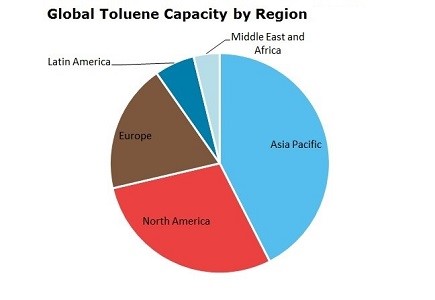
Global trends of TVC (Toluene Value Chain)
Global toluene market witnesses good growth levels supported by demand from end-use sectors. Global demand for toluene was valued at over USD 25.1 billion in 2016. It is expected to reach above USD 31.8 billion in 2021 and is anticipated to grow at a CAGR of slightly above 4.0% between 2016 and 2021.
- Asia Pacific is the largest producing region, followed by North America and Europe. Population growth in Asian Countries along with growing applications of PET and PS will support the benzene and xylene markets, which in turn is expected to drive the toluene market.
- Top 5 toluene producing countries include USA, China, South Korea, USA, Taiwan, and Japan. Out of the total consumption of toluene, 60% is utilized in production of benzene and xylene.
- China and USA consume about 50% of total global output; China and USA consume about 50% of the total global output.
- Asia Pacific is the leading region in terms of demand. Singapore is the major importing source of toluene and UAE is the major exporting destination.
- Solvents production and TDI industries will be the main drivers of global toluene market
In recent times, demand for toluene in India is huge while production is frail. India is highly dependent on toluene imports due to the imbalance between domestic production and demand. RIL, IOCL, BPCL, GNFC and Deepak Nitrite Limited are the key producers of Toluene in India. Demand of toluene is growing at a CAGR of 7.7% from fiscal year 2008-09 to 2016-17 and will be in double digits during the period of 2016 to 2021.
WHAT ARE THE CHALLENGES FACED? Current production of toluene is derived entirely from fossil sources through a catalytic reforming process. With the depletion of fossil reserves, there is urgent demand for the development of new routes to produce aromatics from renewable feedstock.